The skill of the Hudson River School artists is mind-boggling.
Their masterpieces inspire viewers to see and feel the surprising juxtaposition of the pastoral with the sublime. This style is marked by exquisite attention to detail and a brilliant understanding of atmospheric perspective that almost makes you feel the painting is a deep diorama instead of a flat canvas. The “talent” attributed to these artists results from a far more complex formula than a mere genetic gift:
“Talent” = Motivation + study + practice + perseverance
Happily, the modern-day artist Erik Koeppel is providing the world with a fresh collection of masterpieces that clearly belong among those of Thomas Cole, Asher Brown Durand, and other Hudson River School masters.
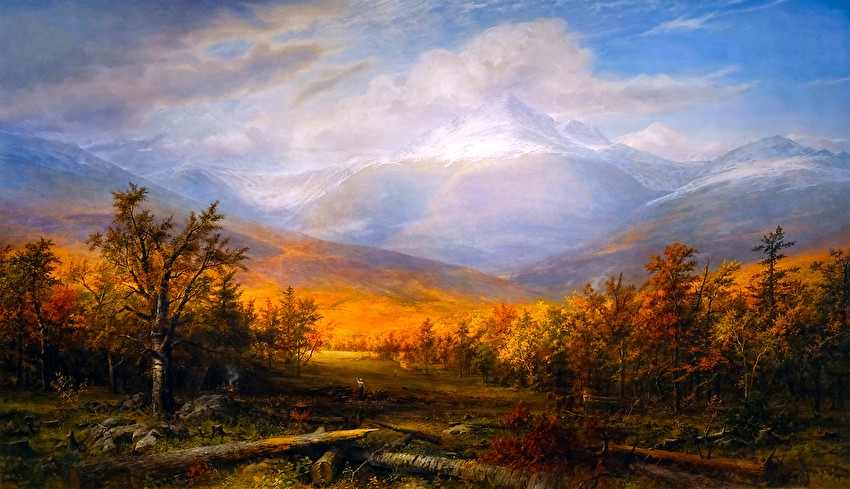
There is so much I could say about the work of Erik Koeppel, but why not meet him the way I did?
Saturday, March 7th, 2026 NH Historical Society, Concord NH presentation by Erik Koeppel
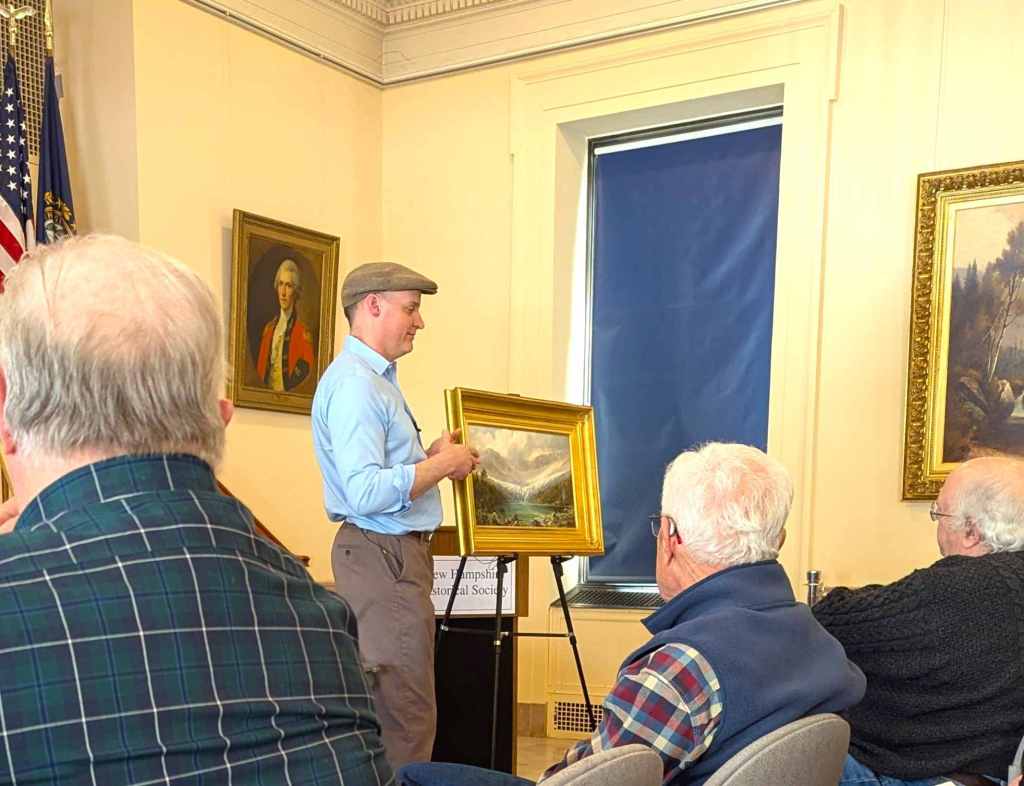
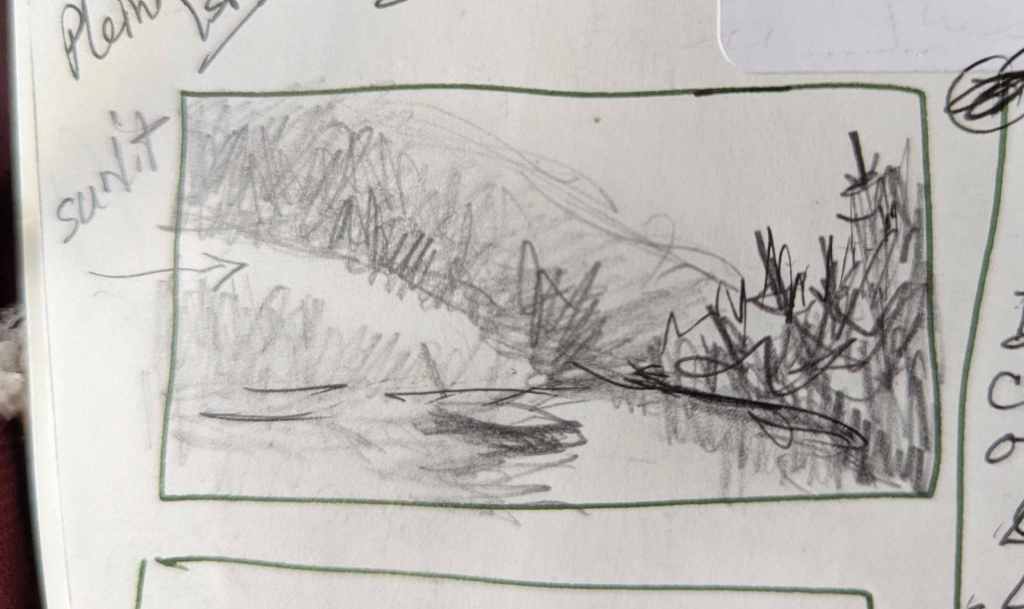
A few of his finished paintings were on display at the front of the room for attendees to study and admire before the lecture began. The attendees were mostly well-to-do retirees, and many had driven for more than an hour to hear Koeppel’s contemporary take on this well-loved style of painting. As I waited, I pulled out my ever-present sketchbook and scribbled a few value studies of his work, proving to myself yet again that I always see more when I sketch.
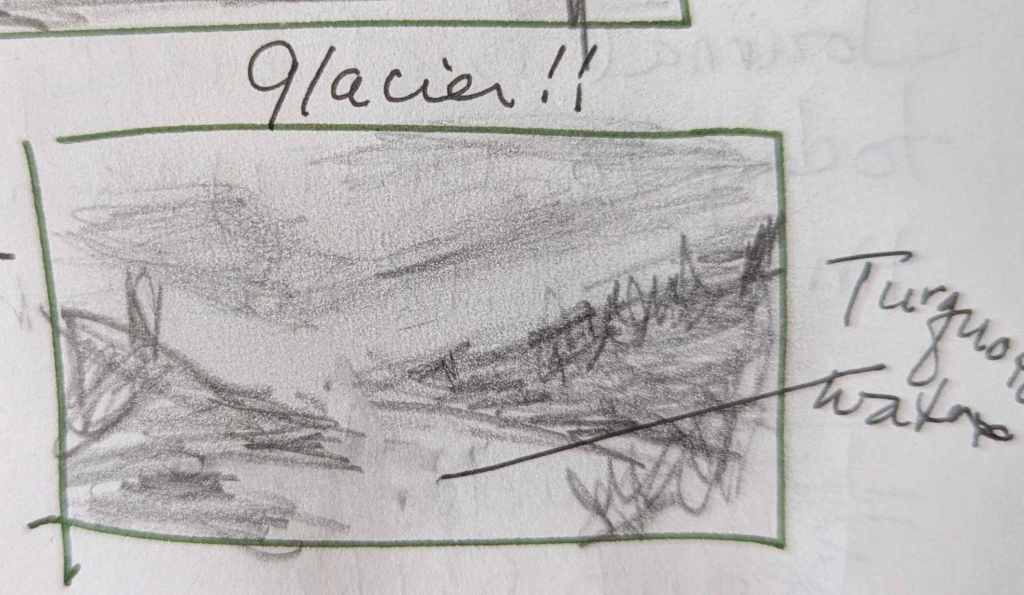
At precisely 2pm, Erik came forward to begin the presentation. To help guide his talk, he asked how many of us were familiar with his work or that of the Hudson River School artists. It became clear we were hungry for whatever he had to share, so he smiled and answered a common question first: how and when did you get into art? (What follows here is not a biography of Koeppel at all. Rather, it is a collection of vignettes from my notes. I hope it makes sense.)
Koeppel said he had been drawing from as far back as he could remember, and that at some point he noticed something different about how it felt for him. He became aware that when drawing pictures as a child, he had a sense of running into the scene he was drawing, and not just witnessing it two-dimensionally like a camera does. Even as a child his mind traveled into his pictures. That is a hallmark of many Hudson River School paintings: the landscapes are designed using color and value strategically to lead the viewer’s eye into the very heart of the painting.
Art Education
After high school, Koeppel attended the prestigious Rhode Island School of Design, and soon realized that commercial art, including the growing field of CAD (computer-aided design), would never be his path. Fine art was his passion, and he was willing to follow that path despite the pressure to develop more commercial skills.
His heart was also drawn to the study of philosophy, including ancient Greek philosophers like Plato and Transcendentalists like Thoreau (who was a contemporary of many of the Hudson River School artists.) Erik explained to us how his study of Beauty and Truth influenced his approach to painting (and went into greater depth on this subject in a wonderful interview with Eric Rhoads that is linked at the end of this article).
Koeppel studied multi-disciplined masters like DaVinci whose curiosity knew no bounds. For example, DaVinci had to understand the mechanics of how water swirls out of a drainpipe and into a pool before he could accurately portray it in a painting. Koeppel seems to have this same sort of hungry mind, studying the patterns and mechanics of an actual waterfall, even when a sudden cloudburst made the soil underfoot increasingly unstable. “Just one more minute!” (If that story makes you smile as you cringe, you may be one of us.)
His artist residency in the Catskills was an immersion experience of plein air practice that deepened his observational skills and increased his appreciation of the Hudson River School artists who had stood in those same places over a hundred years prior.
Koeppel sees his artistic role as a storyteller, not a reporter. He will make several sketches on site, then back in the studio those sketches will combine with his imagination to create an image that looks realistic but is actually a synthesis of many artistic elements.
As an artist, I was especially interested in a story he told about the challenge of art school education, namely curriculum design. One of the enormous problems for studio art instructors is that most instructors are only with a particular student for a few months at best, so neither the instructor nor the student has the luxury of seeing deep skills develop over time. Students are encouraged to be expressive instead, to be “original,” so there is something to show in the spring exhibit (that last assumption is mine, not his). The problem is, many beginning art students have great ideas, but no technical skill to get those ideas onto paper or canvas. (Imagine a beginning piano teacher saying, “Just express yourself, be free!” Never!) Erik kindly explained his understanding of the conundrum facing art instructors, while also understanding how in the long run this emphasis on premature “originality” is a disservice to the student, the instructor, and the school. It reminded me of Ira Glass’ brilliant take on “The Creative Process.” (It’s only 2 minutes- listen to it. You’ll smile.)
A trip North
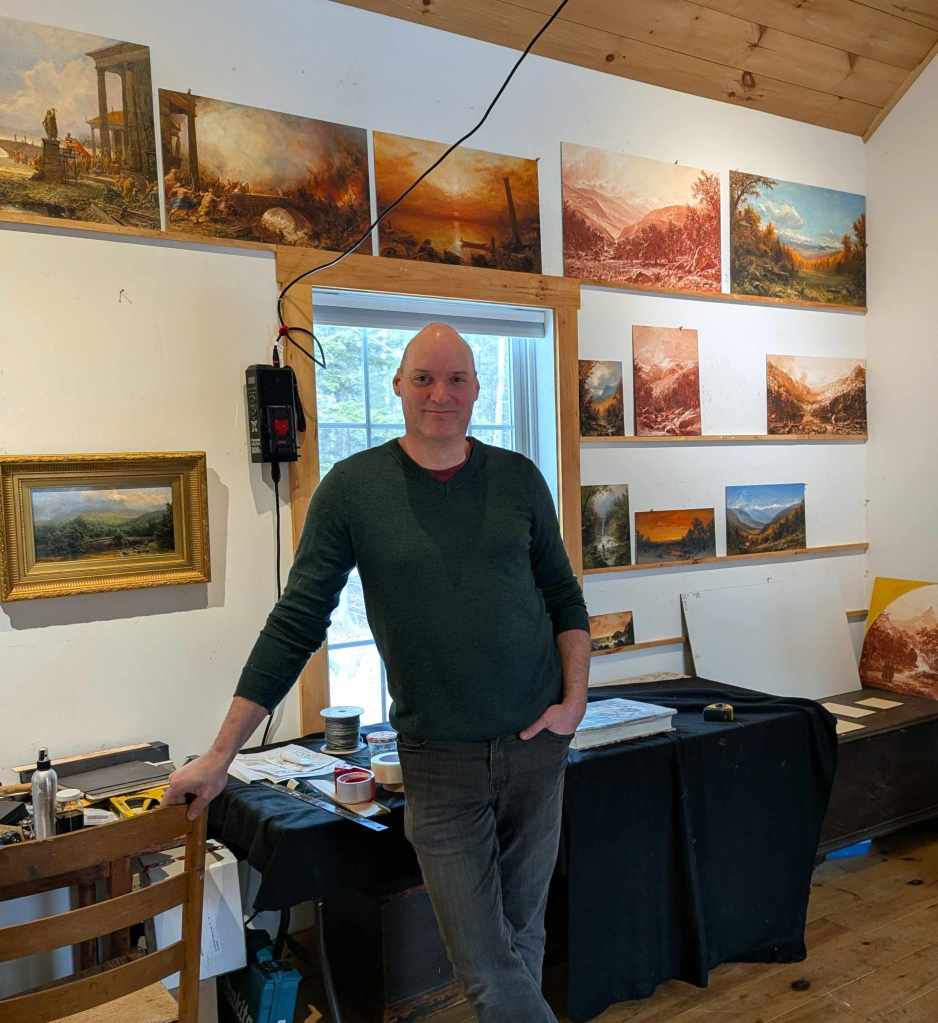
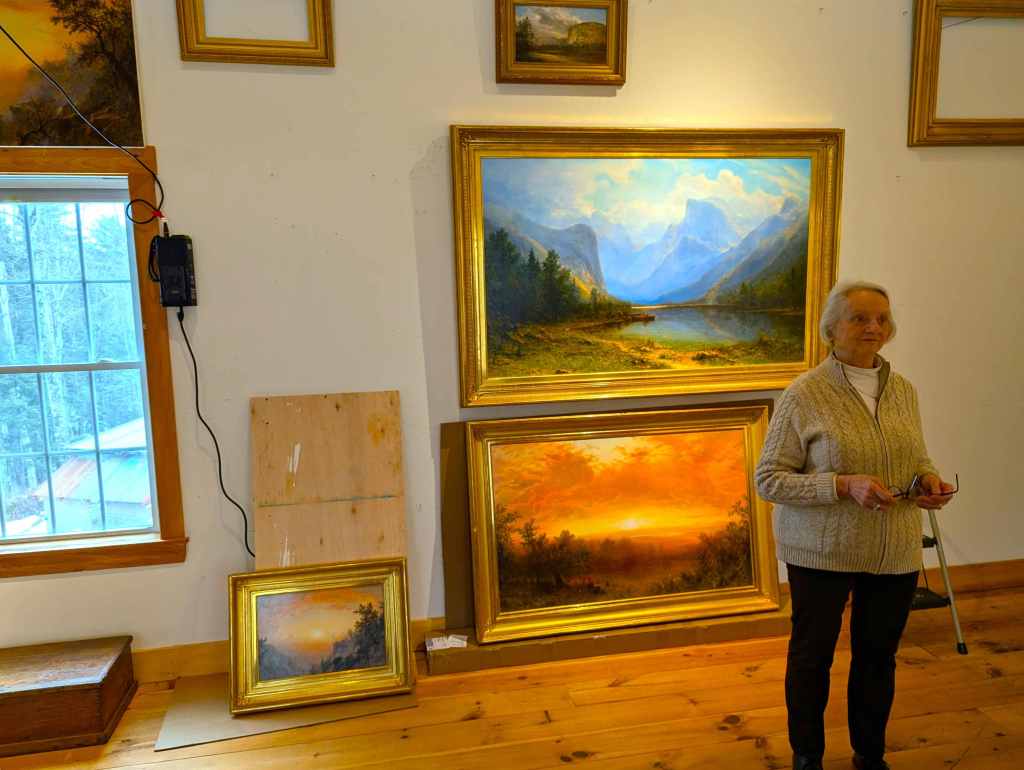
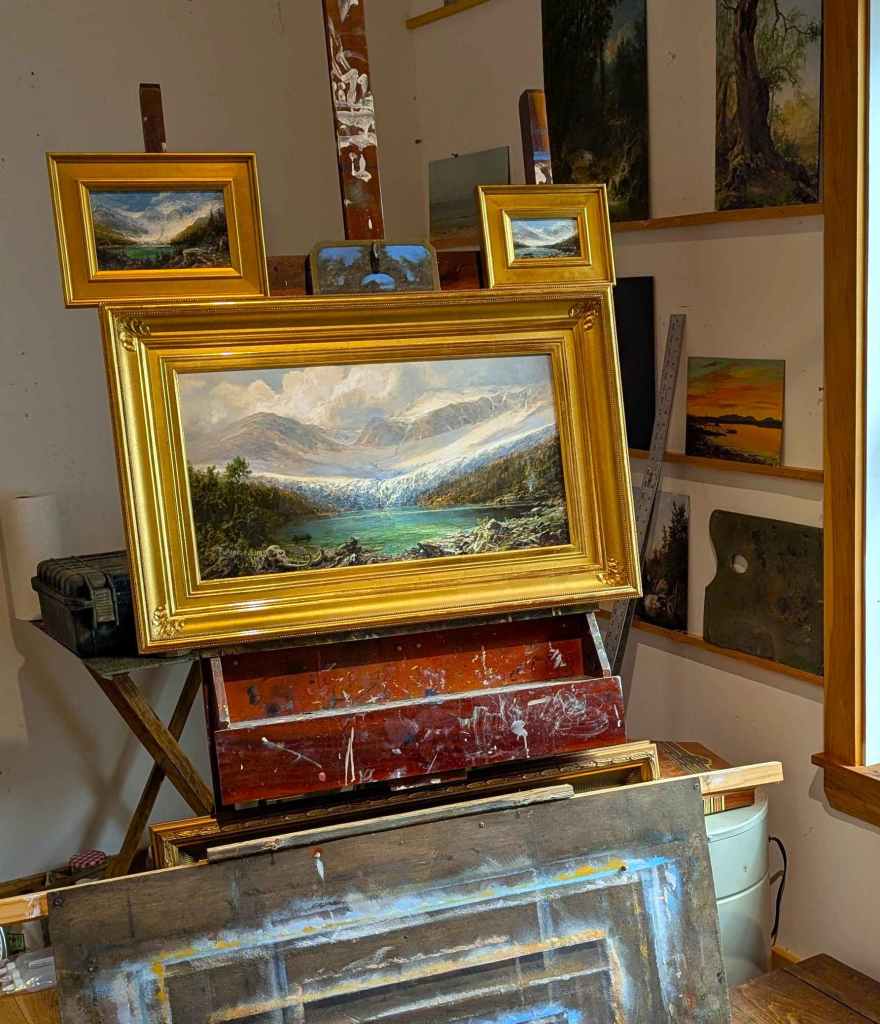
Koeppel also told our group at the Historical Society that he was finishing up a commission that was “large—100 inches across.” We all gasped, and he smiled. He said that if anyone wanted to see it before it was shipped in early May, we were welcome to visit his studio in the White Mountains of NH, about two hours north of Concord. He may have doubted anyone would take him up on that idea. Not me.
I visited his studio two weeks later, on March 19th.
I was nervous meeting him one-on-one at his studio, but his welcoming, relaxed demeanor put me at ease eventually. Let me just say I’m smart, but this guy is brilliant.
Sketchbooks too
In a room full of stunning masterpieces at various stages of completion, I spotted a handful of familiar A5-size black sketchbooks on a side table and smiled. I asked whether he sketches outdoors very often, since his finished paintings are so detailed, demanding hours, days, and even weeks to complete a single painting. He looked surprised by my question, then said he probably devotes equal time to sketching outdoors and working in his studio. It was my turn to be surprised, and pleased, of course. Then he was kind enough to quickly flip through some sketchbook pages that contained quick pencil studies as well as finished vignettes.
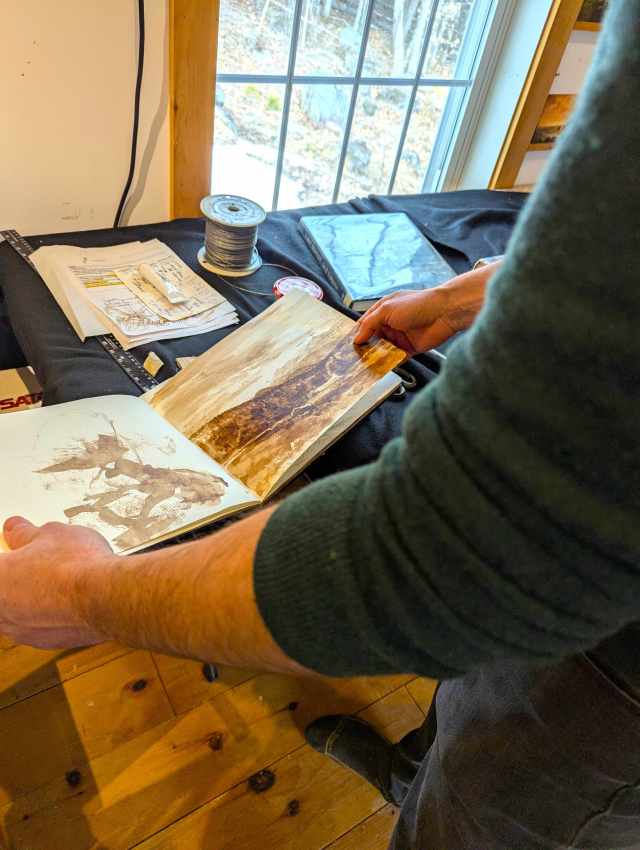
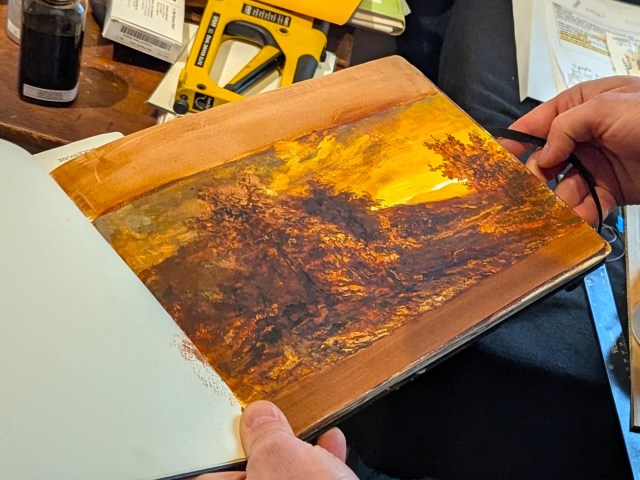
Before his day begins, his morning routine includes a cup of coffee, reading a passage of philosophy, and drawing in his sketchbook from his imagination. Sounds both grounding and liberating.
Final thoughts
My lasting impression of Erik Koeppel is that he is rock-solid clear on how he chooses to invest his time and his life. I believe you get that clarity from paying attention to what makes your heart say a deep and resounding “yes,” and then designing your days accordingly. Perhaps it begins with noticing that when you are sketching a woodland path, you feel like you are walking down that path, not merely sketching it. You get that clarity from hearing the smiling silence within you when painting, gardening, or playing guitar. In your heart, you know.
When I look at one of Erik’s masterpieces, I see attention infused with affection.
He loves this beautiful world we all have the privilege to call home, and he is willing to put in the time, effort, and hard work so that people who may have overlooked it can pause, inhale, and say, wow, yes, thank you.
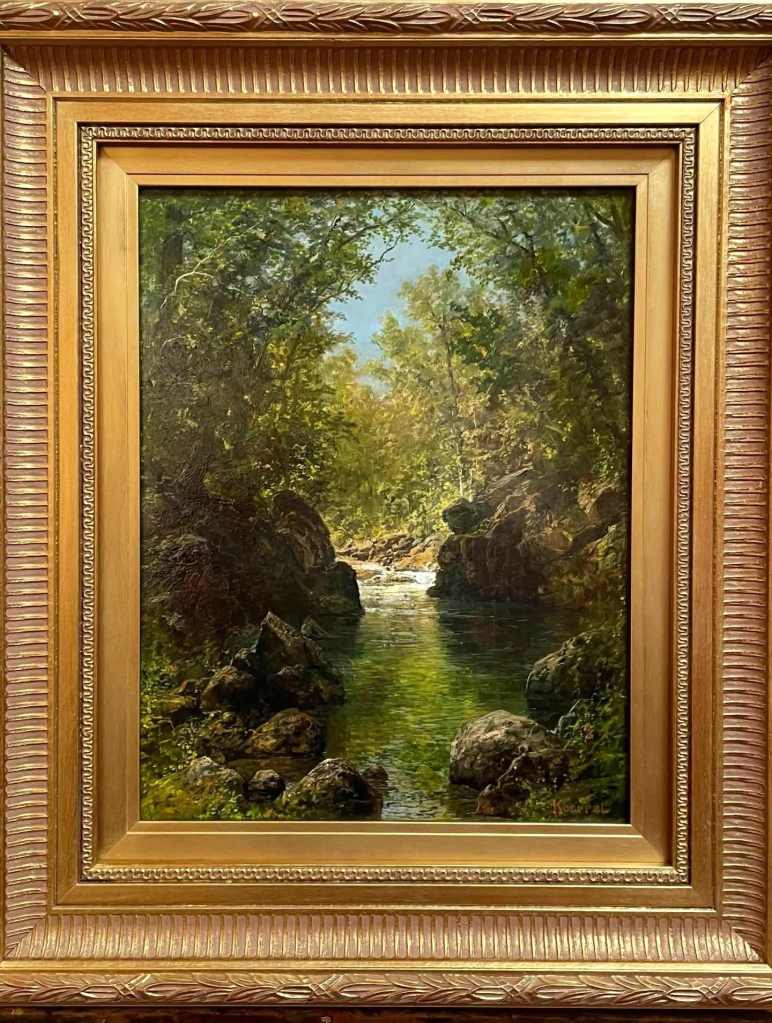
Erik is so eloquent I would never try to paraphrase him, so I highly recommend you pour a cup of coffee and set aside time to watch Erik paint and listen to his thought process in the links below.
On drawing regularly in a sketchbook (3:32 minutes) link here.
Unveiling of the 6.5 ft x 11.25 ft painting installed at the Jackson Historical Society. Link here.
Fascinating talk about the creative process for the huge painting at the Jackson Historical Society “Autumn in the White Mountains” – (29 min) (fast forward 6 minutes to get beyond a promo for a past event) link here.
YouTube 2-Part video (2 hours, 10 min) This 2-hour video can easily be divided into 2 parts: the first half is a narrated plein air demo by Erik, and the second half is a studio interview with Eric Rhoads. Link here.
Spotify Interview: BoldBrush Show Episode #145 (1 hr 24 minutes of artistic inspiration) Link here.
Inspired or intimidated? It’s up to you.
The next time you admire someone’s creative accomplishments, ask yourself, are you impressed by their talent or by their perseverance?
When you feel that combination of excitement and grace, of being in “the zone,” when you are practicing your own creative passion (be it painting, gardening, or something else), I bet you wouldn’t ask how to keep going.
Instead, you’d ask, “Why would I ever want to stop?”
~~~~~~
Feel free to forward this or any post to friends and family who might enjoy them.
Click on the “Word Cloud” on the right if you’d like to read more about a specific topic.
All three of my books are available on Amazon in eBook and paperback formats. The newest book, Look at That! – Second Edition, is also available as a beautiful hardcover.
A big thank you to the recent donors to the Tip Jar. If you find these posts valuable, I hope you will contribute to The Tip Jar. It is my preferred alternative to having this be a subscription website. The Tip Jar is a secure site, and it helps keep this website solvent.
I would love to hear from you! The public “Leave a Comment” box is shown below.
Private questions or comments will reach me by using the Contact link here.


