I pulled this book off the shelf a couple days ago, thinking it was time to revisit its wisdom. Instead, I found some of my own.
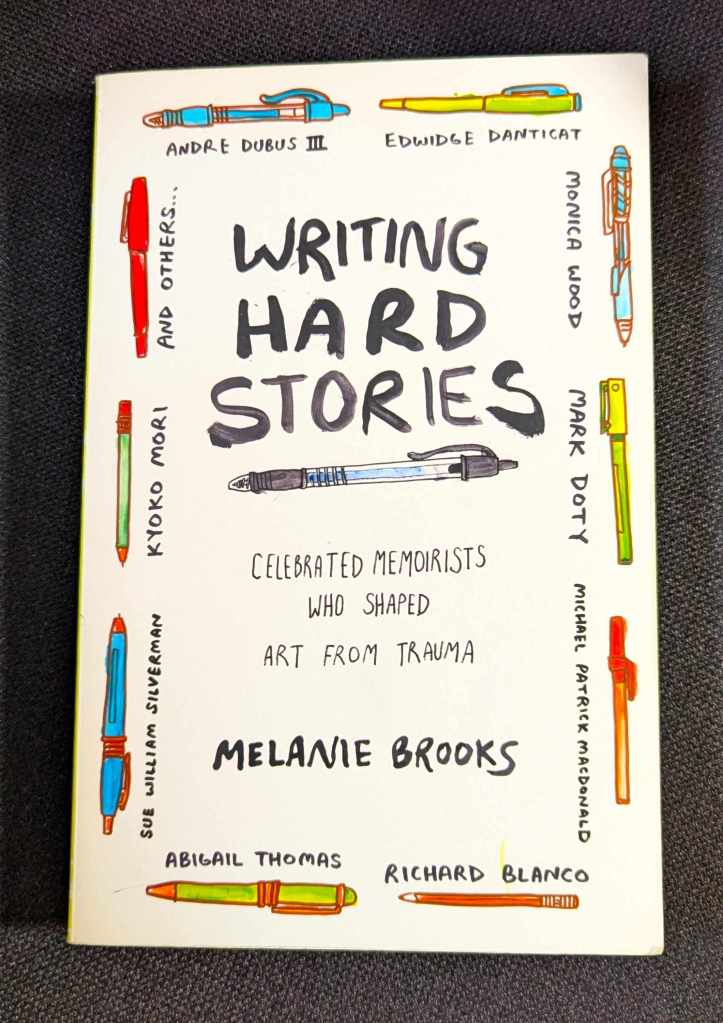
At the end of the chapter about Suzanne Strempek Shea’s work, I found this note that I had penciled in on December 16th, 2022:
“Maybe my urge to write came from desperately wanting and needing someone to talk to, someone who would listen, and care. That someone turned out to be me. I discovered her at the tip of my pencil. …You won’t know if what you write is worth sharing until you’ve written it.”
Now that last sentence may seem screamingly obvious, but it wasn’t for me. For most of my life, if I didn’t know the outcome, I would hesitate to even begin.
“I can’t write a memoir. I wouldn’t know where to begin, where to end, what to include.”
Fine, then just write today’s journal entry.
I can’t play this baritone ukulele I bought; I don’t even know where to start!”
Fine, then just put in 20 minutes a day switching between three chords, not to learn to play, but to build good calluses and finger strength.
“How can I paint a watercolor? I don’t even know where to start!”
Fine, just pick a famous watercolorist you admire, then pick one painting they did, and study it by copying it as best you can.
(News flash: There’s a reason art forgers never, ever try to forge watercolors. It is impossible. Water may cooperate from time to time, but it never really behaves.)
I love the watercolors that John Singer Sargent did later in life. Throughout his art career, he got better and better at looking, seeing, and noticing light, color, value, and composition. Honing your skills in those areas requires no art supplies at all; it only takes time and your precious attention.
For my practice today, I chose his 1910 watercolor, “La Biancheria.”
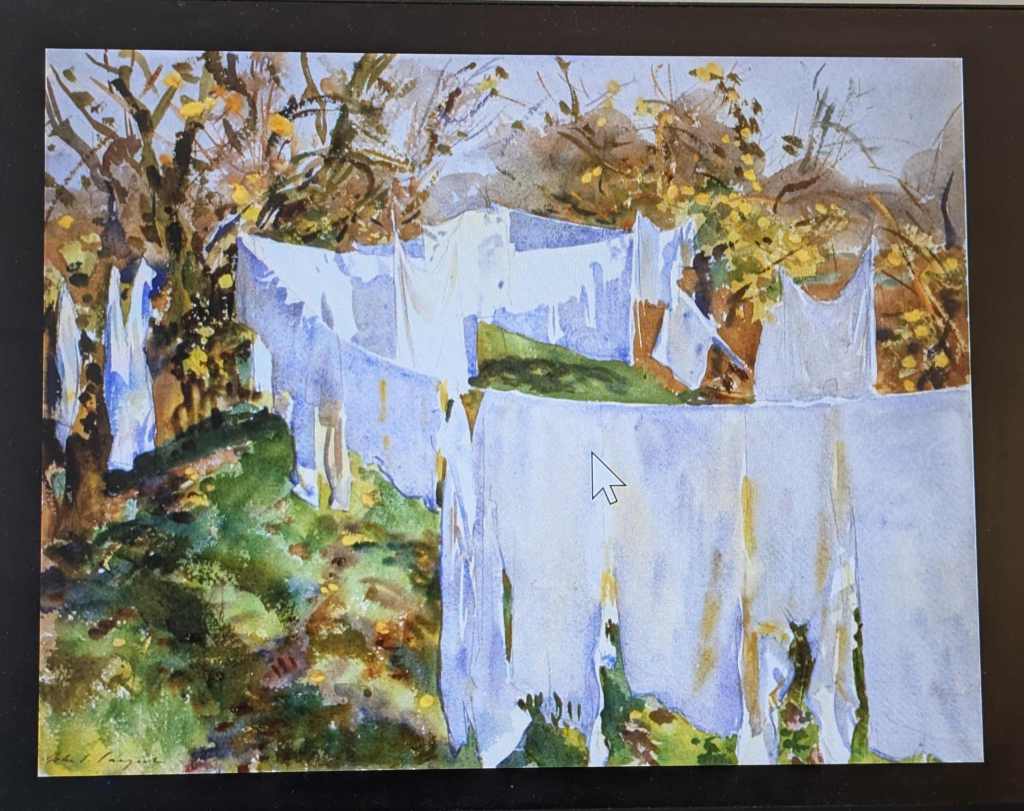
Sargent was 54 years old when he created this painting, having retired from formal portrait work three years prior. Even in his portraiture days, the playful dance of light fascinated him as it reflected off pearls, shimmered through lace, and bounced through tree canopies to land on ladies’ dresses. Many artists such as Degas and Daumier had chosen washerwomen as subjects, bringing to light the chore-laden reality of the working class. In “La Biancheria,” though, Sargent has no need of a human focal point. Instead, he delights in the white laundry itself, the gentle breezes, the autumn afternoon light, all present long after the human has left the scene.
“I don’t know where to start?”
First decision: Minimal pencil work. Basics shapes only. Look, then look again.
“Where does your eye go first?”
To the glorious array of colors in those seemingly white shirts and sheets.
So, study that first. If that’s all you paint, it’s been a good day.
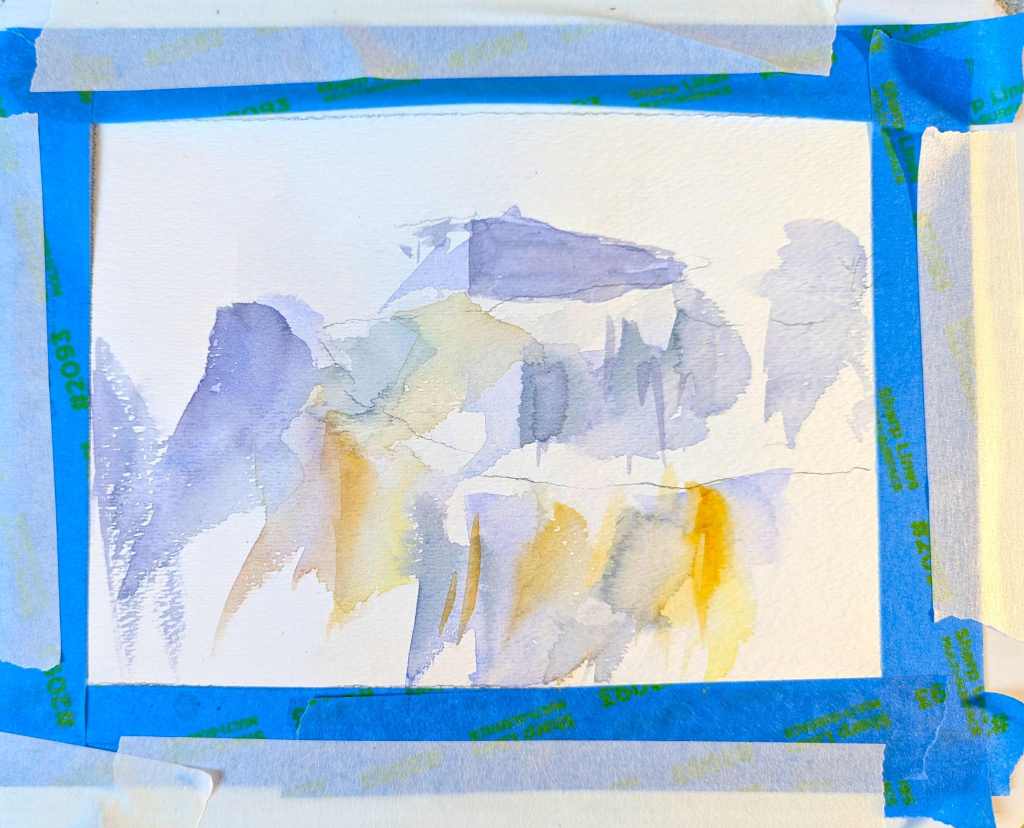
Okay, the shapes aren’t perfect, but the background will be darker, so that can be adjusted.
Then the only thing left was to PLAY. Add in shapes and values and colors of all the background elements, leaving the “laundry” abstract and loose, as it was in the original.
Next the background golds and yellow-greens went in, to create that beautiful back light.
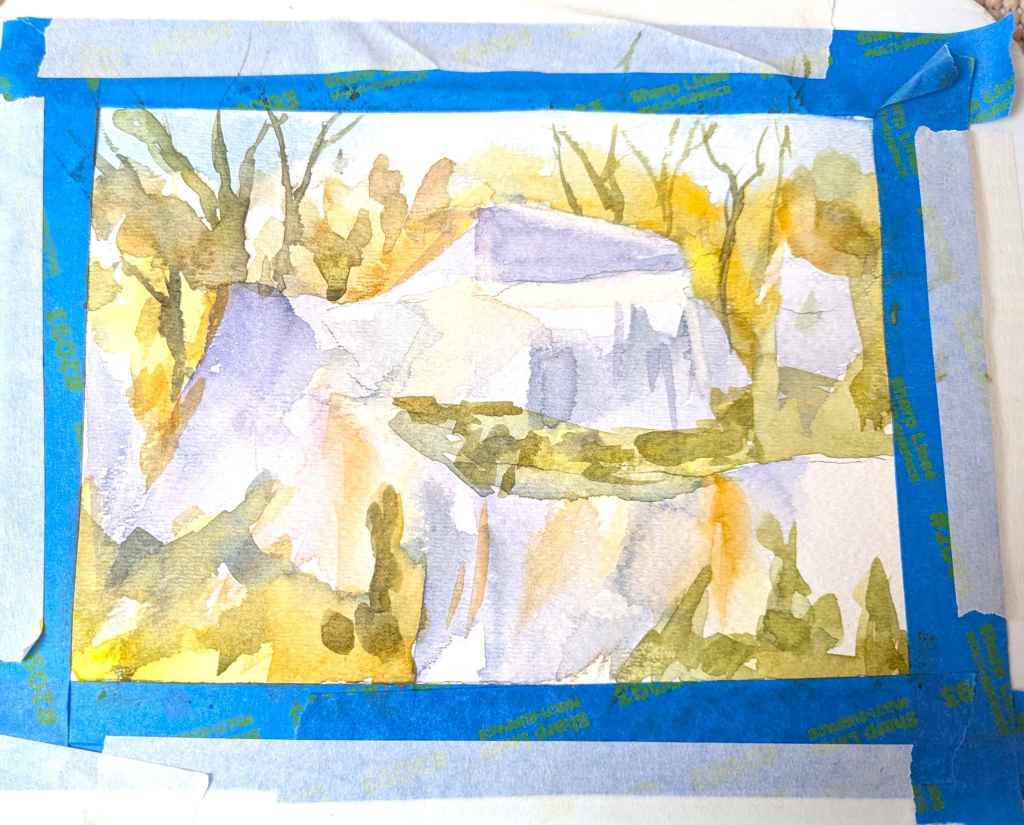
Next, punch in a few darker greens and some hints of trees.
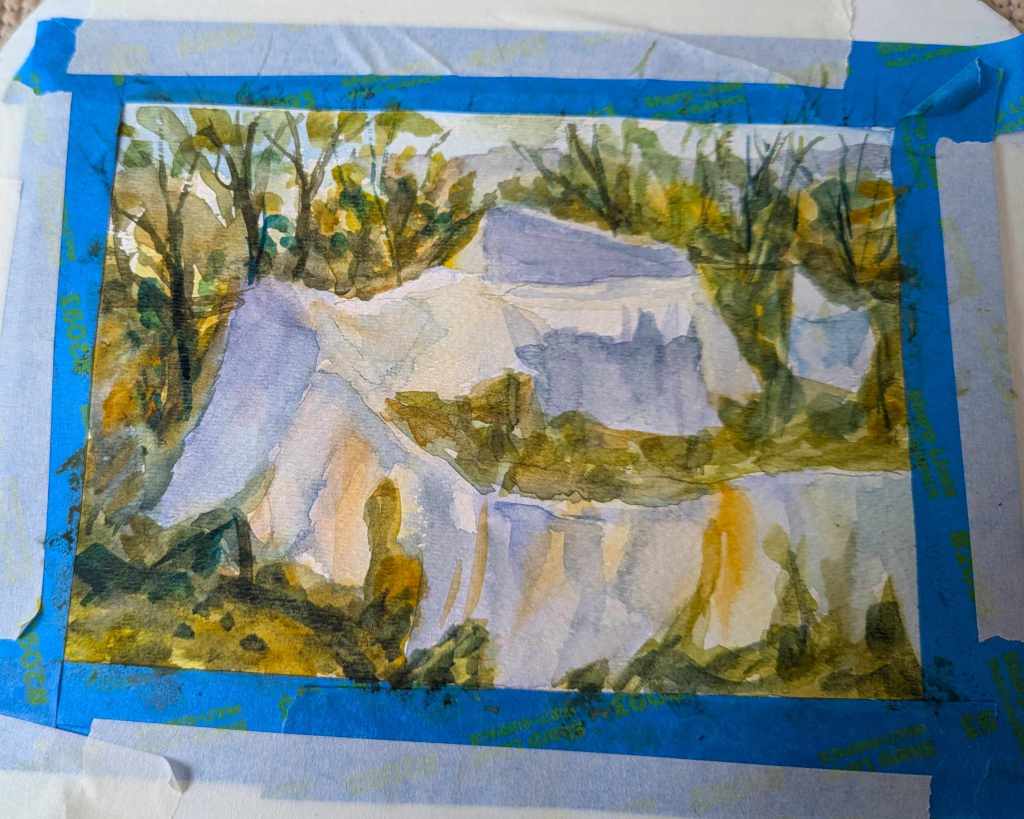
Finally, tidying up sloppy edges and deepening darks as needed.
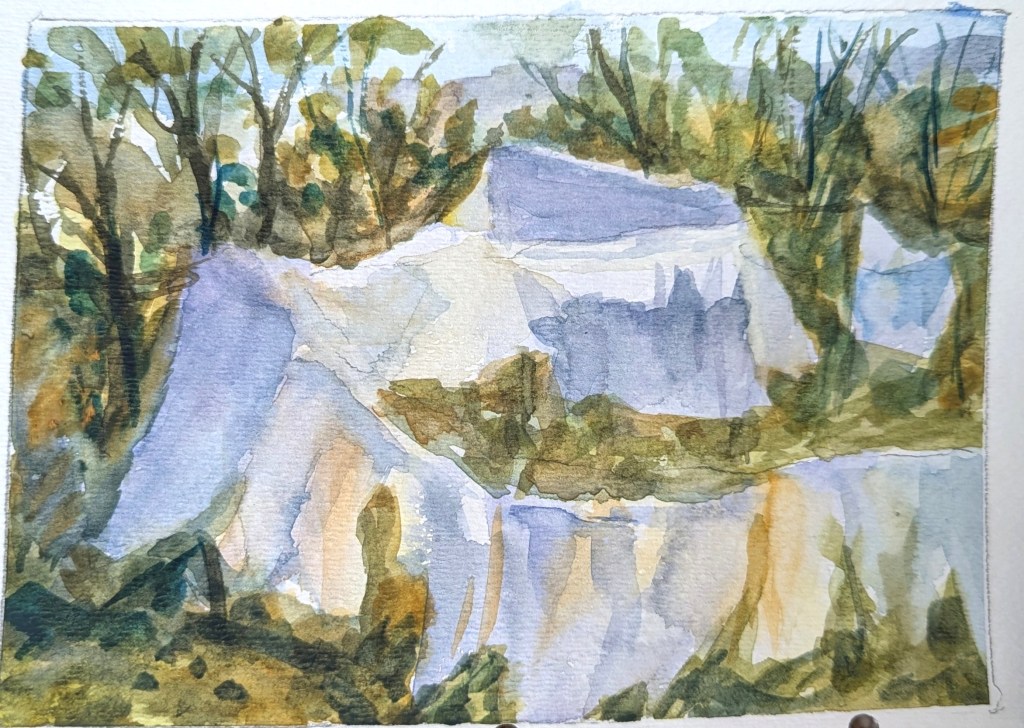
I love when I feel that first nudge of, “Hmmm, are we almost done, or are we going to let Agnes have a go?”
“Agnes” is the critical, fear-based portion of my brain (See Jill Bolte Taylor’s brilliant book, “Whole Brain Living”). Agnes is responsible for jumping to conclusions, fearing failure, and overworking paintings. She is very good at her job. I try to keep her busy dusting and washing dishes and worrying about things that no one really cares about.
Agnes didn’t touch any of the three brushes used in this painting today. (Yes, I know you need to know: A #8 round, a ½” flat, and a #1 rigger.)
The colors used were 3 yellows, 3 blues, 2 browns. That’s all you need to know.
That’s it. I have no idea how Sargent did this, so I approached it the way that works for me.
1- Do the fun part first.
2- Then look around for the next part that looks interesting.
3- Do Not Have A Plan. Follow your heart instead.
That way, no matter how it turns out, you had a good time.
It is my job to know how to refill my resilience reserves—for me, music, watercolor, and writing work well. I wish you great success in discovering, honoring, and practicing whatever activities make your heart sing.
~~~
Feel free to forward this or any post to friends and family who might enjoy them.
Click on the “Word Cloud” on the right if you’d like to read more about a specific topic.
All three of my books are available on Amazon in eBook and paperback formats. The newest book, Look at That! – Second Edition, is also available as a beautiful hardcover.
A big thank you to the recent donors to the Tip Jar. If you find these posts valuable, I hope you will contribute to The Tip Jar. It is my preferred alternative to having this be a subscription website. The Tip Jar is a secure site, and it helps keep this website solvent.
I would love to hear from you! The public “Leave a Comment” box is shown below. Private questions or comments will reach me by using the Contact link here.

 Aloft with Inspiration
I loved seeing your process and steps. Very interesting!
LikeLiked by 1 person
Thanks, Ginie!
LikeLike
Bobbie, I had written to you way back. Kept thinking that I would comment each time you write. At 80 I am not as quick as I once was. You are such an amazing person! Your words give such wisdom and common sense all at once. I think of you often. As I look at our unique snow-crete [being called that by weather people; had 5-6 inches snow and then 4-5 inches of sleet on top, cannot be shovelled [sp?] or driven through] that came on January 25, I think of you probably getting much more. I like the snow since it is so beautiful and because it covers all the browns and dreary. Take care. Share with us as long as you can. You are a blessing in so many ways.
Elaine H. McGann, VA
LikeLiked by 1 person
Elaine, thank you so much for your kind, generous words. I have enjoyed our correspondence over the years, and am so pleased this blog resonates with you. I believe we are kindred spirits in many ways. “Snow-crete” is the worst, yes, I am very familiar! It is a balmy 8 degrees F at the moment, but warmer days are coming. Take care, and thanks again.
LikeLike