I have heard people say, apologetically, that they took “artistic license” when they changed a scene they were trying to draw or paint. I get it, but they’re wrong to apologize. The truth is, your artistic license needs to be used often; it is basic equipment.
Here are three quotes from my brilliant mentor of many years, Ron Ranson:
Design: “What seems to divide excellent and lasting from mundane and forgettable works is the underlying design control…Nothing really separates the amateur painter from the professional more than this basic abstract organization of elements.”
Choices: “Realize that as an artist, you have the power to select or reject. Use the scene before you only as a starting point.”
Simplicity: “Simplicity can only be achieved by forethought, planning and insight. It actually takes much more effort to create a bold simple painting, than to endlessly worry and poke a picture to death.”
I do love the way he talks.
I believe that good design instincts are innate in many of us, and happily that inner knowing can be sharpened and improved through study of design winners and losers. That’s the purpose of this post, and I’m happy to share both of mine!
I started with this photo that I took recently while walking through the campus of a nearby boarding school. I was enchanted by how a formal staircase and Narnia-esque lamppost appeared out of nowhere as my friend and I strolled along a woodland path.

I thought, “Right, I’ve got it. All I have to do is a bit of cropping and editing and voila, this’ll be easy.”
Despite doing a few cursory thumbnail pencil sketches of the design, I still made the mistake of letting the center of interest drift to the center (Design No-No #1).
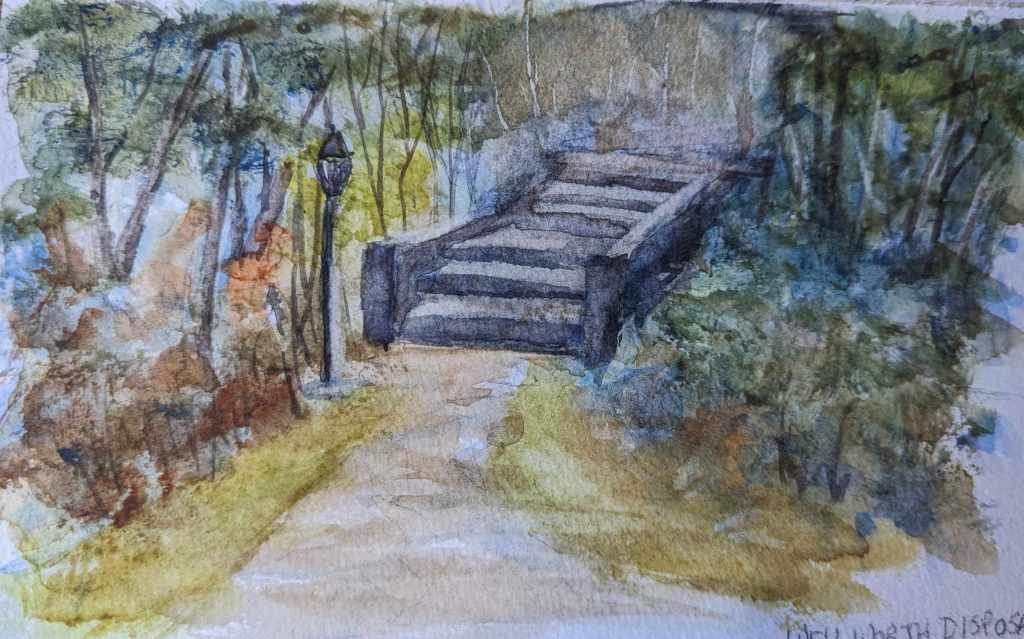
What a disaster! I forgot that the only way to give the viewer that same “aha” experience I’d had, of a half-hidden distant woodland staircase, was to keep the stairs in the distance! Instead, I zoomed in by mistake, thus eliminating that enticing foreground. Not a speck of paper was left white either, it was all soaked with hesitation and self-consciousness. The curious lamppost became a mere add-on, and although you might not be able to tell, I did “worry the paper to death,” rewetting, lifting, repainting, criminal behavior really.
Finally, thankfully, I gave up. There was an audible sigh of relief from that page in my sketchbook.
Two days later though, I decided to give it another go. I’m in the middle of rereading the chapters in “Big Brush Watercolor” where Ranson gives vivid examples of how photos can be used and even combined to inspire a credible, imaginary scene that began as a mere twinkle in the artist’s mind.
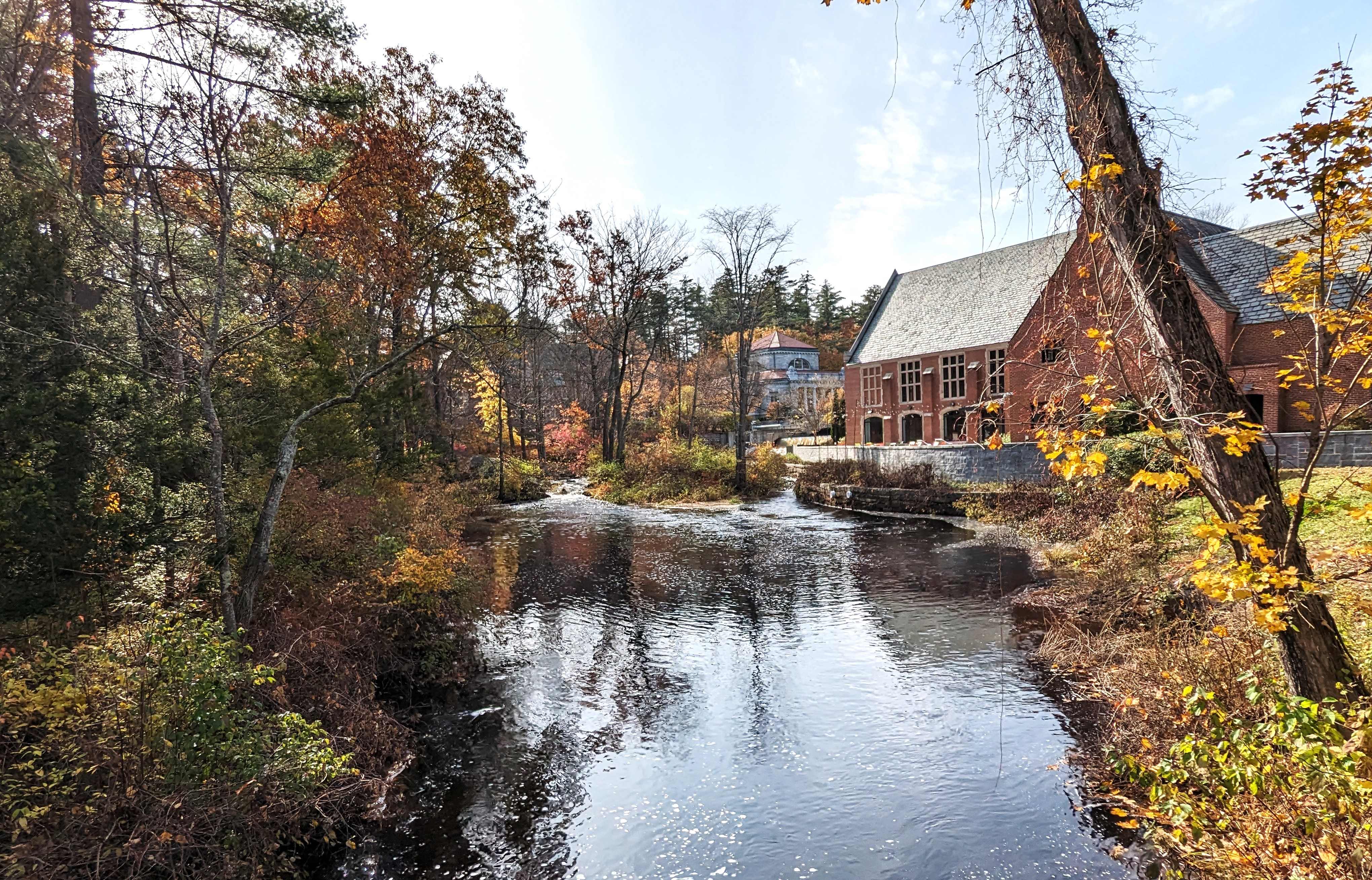
I chose a photo of the nearby river and campus buildings as a context for this staircase and added a bit of sky to broaden the view.
Here are the two photos:

I looked at both images for a long time.
Then I closed my eyes, literally, and just sat, breathing slowly. I imagined how that scene might look in rural England, where a boys’ school, located across the river from a small mill town, might have a walking path through the campus forest.
I saw it in my mind, smiled, opened my eyes. I drew two or three faint pencil lines to orient myself to the page, and the rest was done in no time.
Here is how the final design looks.
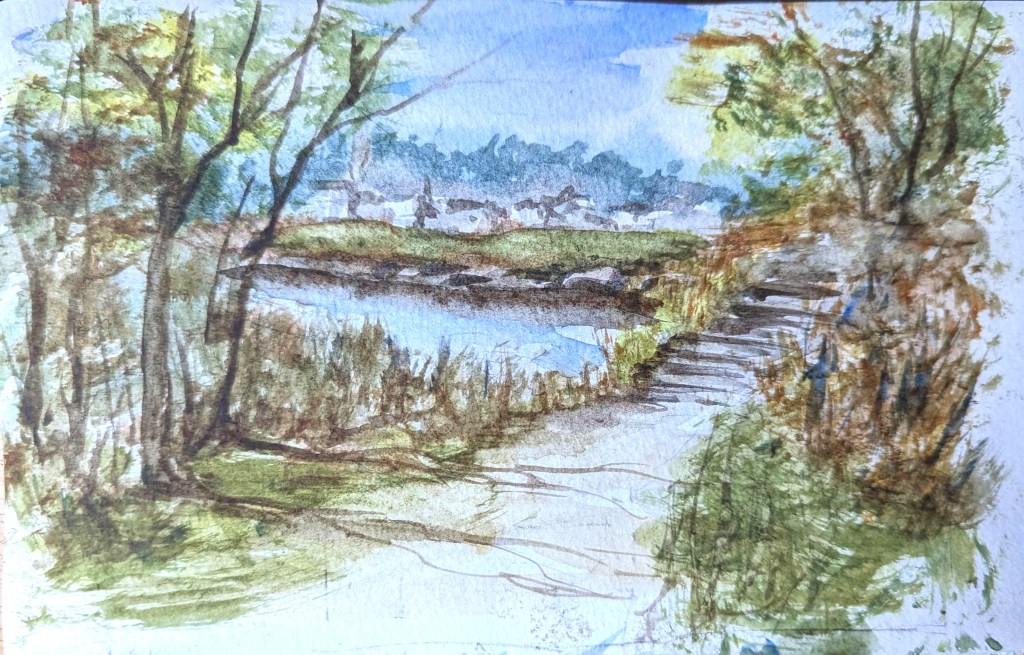
It was more fun, more creative, more liberating, than any slavish loyalty to a photograph, even a good one.
Takeaways:
As some of you know, I am in the middle of writing the second edition revisions for Look at That!, my sketching primer I published in 2020. A couple “Bobbie-isms” I may include are, “Think or Paint: Never both at the same time!” or “Painting is NOT a contact sport!”
Give yourself time to do the design work in your heart first. Let the design come to you. When you transfer the image in your mind to your paper, pretend every pencil line costs a dollar, and every brush stroke costs $5. Pause, paint, smile, pause, paint. Doesn’t that sound like more fun than, “Argh! Ugh! I suck at this! Where’s the eraser? Why did I use staining colors? I want to lift that!”
Ssssh, no, no, no, breathe. As Mihoko taught me, “It is only paper. No one will die.”
Remember: you draw, and paint, and sketch, and pause to look around you for joy, and joy alone.
There is no homework, only heartwork. And even that can be play if you let it be.
*******
Feel free to forward this post to anyone you think might enjoy it.
If you find these posts valuable, please consider making a one-time contribution of any size to The Tip Jar. It is a secure site, it helps keep this website solvent, and is greatly appreciated!
Questions? Comments? Public comments can be posted below.
Private questions or comments will reach me by using the Contact link here.
And, as always, thanks for spending some time “aloft”!


Very interesting post . As you say we may not forget the pleasure and to smile , great reminder , thanks !
LikeLiked by 1 person
That’s a great post Bobbie and such a good reminder to all of us not to become slaves to the scene in front of us. You’re final sketch was a great combo of the two photos.
LikeLiked by 1 person
Thanks Andy! I love it when an unsuccessful painting inspires me to give it another go. Never give up, right? Your weekly posts always inspire me.
LikeLiked by 1 person