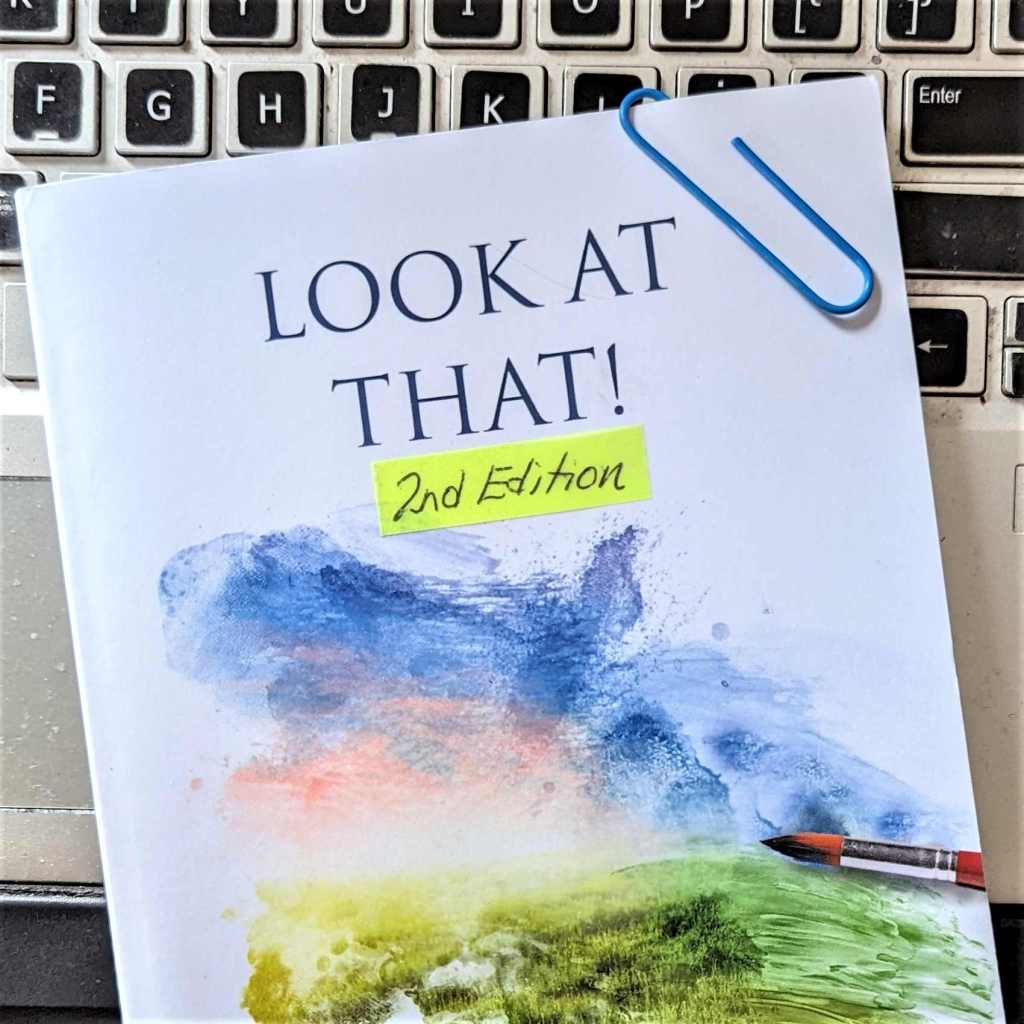
Three years after publication, and after over 5,200 copies have sold on Amazon alone, I’m thrilled to announce that my first book is getting a major makeover.
The changes feel substantial to me, and yet I realize that when you see the new version, you might just smile and say, “It’s still the same book, just a bit better.” And you’d be right, but there will be one huge change:
Finally, there will be print on the spine! In other words, “It will no longer look spineless!”
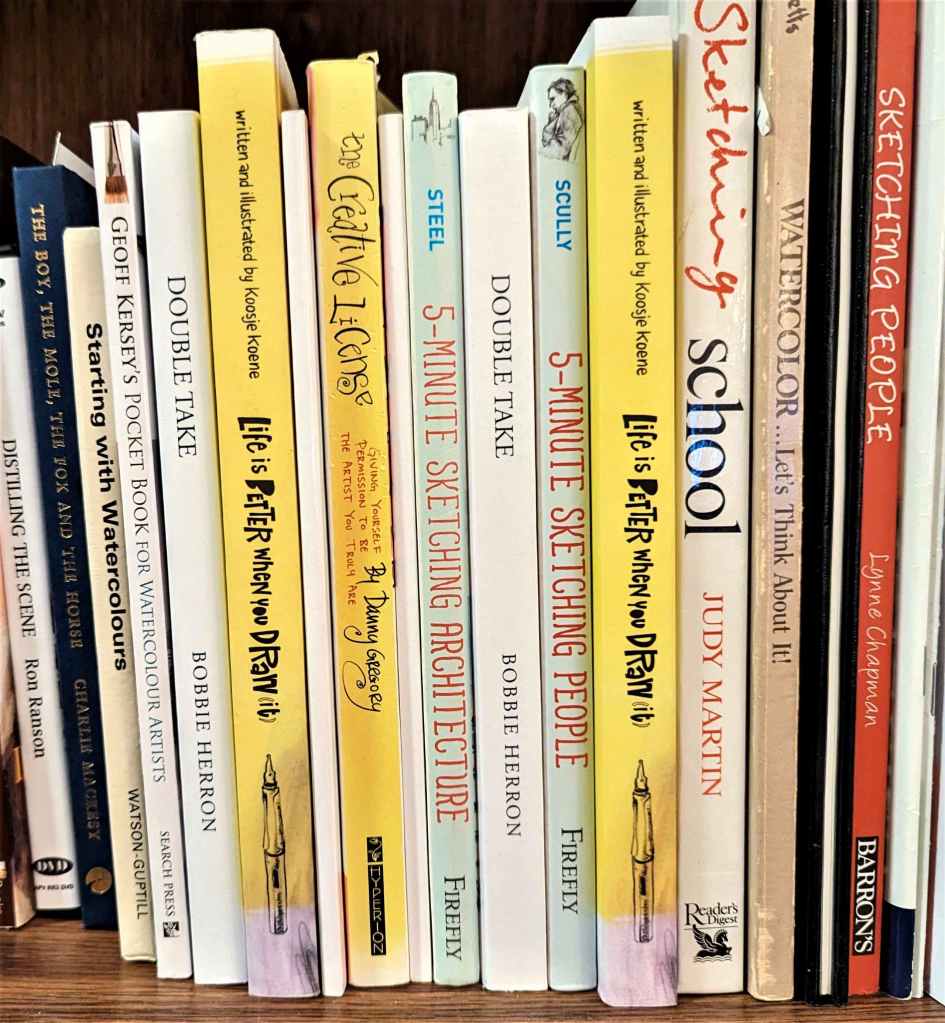
Does it really matter that there is no print on the spine, that it doesn’t say those five simple words, “Look at That – Bobbie Herron” along that skinny ridge?
It certainly does.
No brick-and-mortar bookstore will carry books that have no print on the spine for one simple reason: they don’t sell. They don’t sell because they don’t “shelve” well. (See photo above.) Beyond that, sadly yet understandably, most public libraries will not even accept the gift of a “no-print-on-the-spine” book.
That is why almost all my sales have been through Amazon. No bookshelves, no problem.
This serious design flaw, made back in late 2020, was not an oversight, far from it. I had so many go-rounds with the designer, endless delays, and we were way past my initial deadline for publishing. When the final cover file was sent to me, I said with polite exasperation, “The writing on the spine was there in the approved draft sample, but now in the final version, it has vanished. Please fix asap.”
It was only then that I learned the design he created was too few pages to have print on the spine. I was told at the time I needed 100 pages minimum, a far cry from its final length of 72. To add 28 more pages would have been a 39% increase (!), requiring an entire redesign and additional chapters. It was far too late to make the changes and still publish in time for the 2020 holiday book sales season, so I took a deep, sad breath and had to let it go as-is.
In truth, by that time I was so burned out on the entire self-publishing process that I was eager to be done with it. By the end of November 2020, I was convinced this tiny book had been simply a vanity project. I had no idea it would end up on the Amazon best seller list with over 400 mostly-glowing reviews. What a delightful surprise that has been these last three years.
Is a minor revision possible now?
Earlier this year, I discovered that “100 pages” is not the minimum book length for a printed spine (as I was told back in 2020), but instead only 80 pages were needed! Hurrah! I eagerly began working on a plan to salt in those additional eight pages to get my grand total up to eighty, while also making a few minor changes. I was humming along, staying within the prescribed “maximum 10% changes” publishing rule for the whole book, ignoring the many minor changes I might have made had there not been such a rule. Keep it simple, get it done easily, quickly, and for free: that was my goal.
Then a week ago I stumbled across an additional detail hidden in the fine print:
“The 10% maximum change rule also applies to the number of additional pages allowed.”
The math was simple. Adding the crucial 8 pages is exactly one page, ONE PAGE, more than I am allowed to add to this first edition. 72 x 1.10 = 79.2, not 80. No, they don’t round up. If there had been 74 pages to begin with, I could have slipped in six more pages easily, but 72 pages is a deal-breaker.
My soul flashed back to the many publishing frustrations of the Summer of 2020. Expletives were muttered. I was fuming.
But then a few hours later, while I was washing dishes and trying to think about other things, an effortless insight arrived, a nugget of universal wisdom about Life Itself.
Suddenly, my soul went from:
“I am so angry I now have to go through the expense and hassle of creating a Second Edition, just to get that print on the spine!”
to
“I am so excited! I now get to create a brilliant Second Edition!”
That’s the nugget: When you shift “I have to” into “I get to,” everything changes.
You might be thinking, “Bobbie, you’ve lost me. What’s the difference between making changes to a first edition, and publishing a whole new Second Edition?”
What is a “first edition” anyway?
A book can still be called a first edition if only minor changes are made to it. That’s for good reason: if someone recommends a book they read last year to a friend, the friend should be able to buy it now and get the same book, or a very close version of it. You can fix a typo here and there, or adjust a tiny graphic element, but it should be essentially the same book. That’s the reason for the “maximum 10% changes” rule. It’s hard to stay within that guideline if you really love your book and want to improve it as much as possible.
The good news, if you stay within that 10% restriction, is you get to keep the same ISBN, all the online reviews, all the Good Reads reviews, all the bestseller status history, your Library of Congress number, etc., because all of that is tied to the ISBN (International Standard Book Number), found on any copyright page. It is your book’s one-of-a-kind DNA code.
What if you can’t stay within that “10% change guideline?
The bad news is then you have a lot more work and expense ahead of you, not in editing the book, no that’s the easy part. The difficulty, and expense, is in making sure your Second Edition is connected everywhere to the first edition, including reviews, recommendations, etc. The publishing costs for a Second Edition are more like that of a brand-new book, with extra effort and expense to carry over the history from the first edition to stay with the second. That’s where my original angst came from. Put simply: many more things can go wrong.
The good news is now I get to fix absolutely every little thing I want! I know the revised version will still be enough like the original that it will easily pass for a Second Edition rather than a brand-new unrelated book.
The fundamental difference will be in my level of delight: now I can fix, change, add, delete, improve everything including the layout itself. Add more space to breathe. Have clearer contrast, more visual appeal.
Best of all, I’m working with a new designer who 1) knows the software inside out and 2) is blessedly easy to work with. Her sense of aesthetics is similar to mine, and she intuitively understands the principle of “Less is More.” This is so important in a heavily illustrated book: the last thing you need is for the layout to be arm-wrestling with the illustrations for your readers’ attention.
The next cover will remain essentially the same (except for the addition of that beautiful new spine!), and the book itself will still be concise (about 84-86 pages, I think). I have no deadline, although releasing the Second Edition this November, three years after the first, would be kind of sweet.
So here’s my question for you: How would you like to help me?
Many of the minor adjustments I am making are thanks to reader comments I have received in the last 3 years. For example, the “Infamous Purchase Order” (current page 65) needs to be simplified. The resources on page 67 will change a bit because some of those are no longer available, and I want to add other wonderful artists (like Hazel Soan) to the list. Some of the current images will also be replaced with clearer ones.
Here’s how you can get involved: if you have a paperback copy of “Look at That!” and have studied it:
Were there any pages you found confusing?
Were there any sections that you thought needed more information, or another illustration?
Were there any sections that perhaps should have been simpler?
Would adding an index be helpful?
Is the print size user-friendly?
Anything else?
Write to me soon, either here in the comment section below, or privately using the contact page link here.
This is going to be so much fun, I’m glad I have sketching buddies to tear me away from my laptop regularly to go outside with them and…Look at That!


Congratulations! 😀 How exciting to finally have spine text.
LikeLike