(From the “Don’t Get Me Started!” series.)
I need to make peace with how “Art History” is taught.
In America, college “survey courses” are offered to the general student body to ensure that all students are exposed to topics they might never have chosen on their own. They can be rich and wonderful opportunities, but there are two potential pitfalls: one, survey courses (whether you’re interested or not) are often required for students to graduate, and two, these classes are sometimes assigned to the most burned-out, least interested faculty members.
If the professor isn’t interested, why on earth should the student be?
This was my experience during the full-to-capacity Art History 101 course I attended during my freshman year of college. There we sat, elbow to elbow in a darkened auditorium, watching images stream by in rapid succession, while listening to a professor who didn’t want to be there.
The room was too dark for any of us to take notes, so we passively listened as the instructor’s monotone voice recited the name of the artist, the birth and death dates, and the name of the painting or sculpture. Students around me were muttering, “Who cares?” and sadly, I was feeling the same thing even though I was an art major. I wanted to care, but something was missing. Actually, a lot was missing.
- Historical context was missing.
- A deeper look at the handling of the art material itself was missing.
- The clues about why this particular painting was important were missing.
- Most of all, the professor’s passion was missing.
I bet very few of those students went on to have even a passing interest in art or art history, which is sad. Sadder yet is the fact that our Western culture is as much to blame as that professor.
Somewhere along the line, probably around the time of the industrial revolution, home-based recreational pastimes like playing piano, drawing, basic crafts and art hobbies began to disappear from daily life in much of modern America. Hobbies were out, productivity was in. Since there was no profit margin in whittling a stick or playing piano or drawing a dandelion, any interest in this sort of activity was slowly relegated to “those people,” you know, the “creative types” who, of course, used to be all of us. If you weren’t instantly plunking out beautiful melodies or creating inspired doodles like a child prodigy, you were quickly told, “Don’t worry, not everyone is artistic—why don’t you try out for the ball team instead?” Even if you never excelled at sports, everyone knew it was still good exercise.
What went unnoticed, unfortunately, was that “playing art” was also good exercise, just in a different way. Drawing and painting strengthen eye / hand coordination while at the same time giving the brain moment-to-moment practice in observation, re-evaluation, and problem-solving. What great life skills! Best of all, as we drew our wonky pictures, we were learning to see those first failed sketches as a perfectly natural part of the learning process. We got to enjoy ourselves while learning the rewards of gentle perseverance.
Sadly, many people at a young age were told, “Forget that artsy stuff. Why not try something practical, something that could actually lead to a career?” Ah yes, let’s get capitalism as close to the crib as possible.
Art History as Gossip: The Artist as a Circus Sideshow
Sometimes art history instruction focuses more on the artist than on the artwork itself. Art historians love stories about the individual artist’s personal life, their quirks, their struggles. The risk here is that in focusing on the artist’s social circle and idiosyncrasies, we get further and further away from looking at their body of work, turning them into a circus sideshow rather than simply one of us humans who had a passion for observation and image-making.
On pain of death, do not put words into an artist’s mouth. Ask them, interview them, then listen. If they’re no longer alive, read their published writing. Assume nothing.
I attended an online class recently about a Hudson River School artist named Frederic Church who lived from 1826 until 1900. During the Q & A toward the end of the presentation, the professor was asked what the artist had had to say about his own work. After a brief hesitation, her answer was clear: he never talked about it. He refused to explain his paintings.
Right, so here we are. Speculation has its place, I understand, if the speaker is clear they are sharing their own ideas, not those of the artist. To say that an artist was trying to convey a certain emotion or tension or political stance, when the artist said no such thing, is a serious injustice. Certainly, an art critic can have that idea, but it is their idea, not that of the artist. When the line between speculation and attribution becomes blurred, scholarship fails miserably.
(Now do you see why this series is called: “Don’t Get Me Started!” ?)
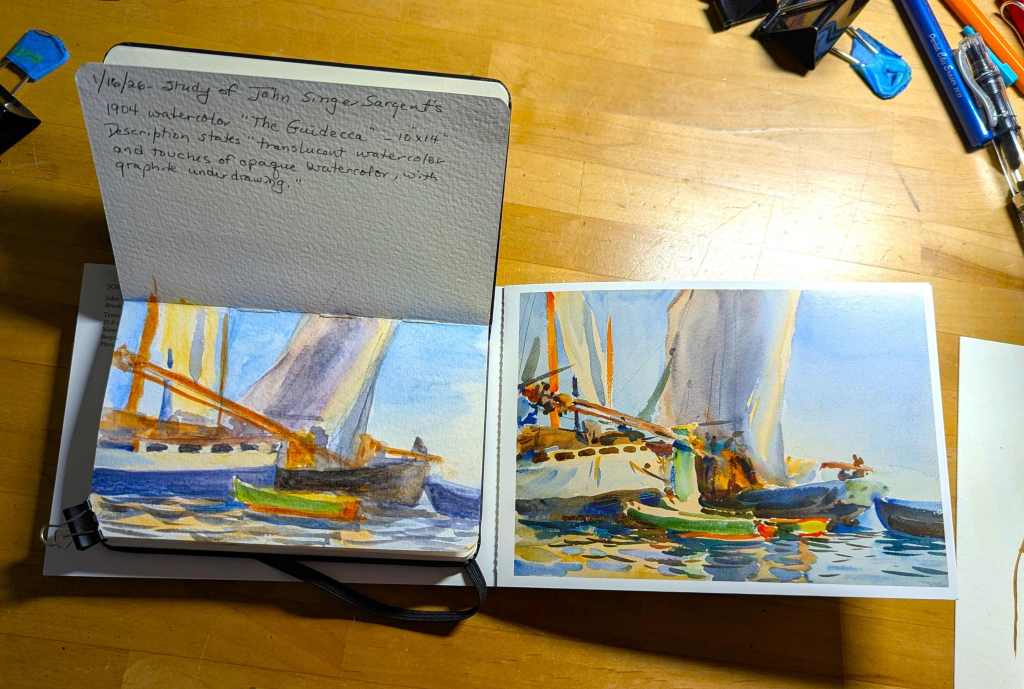
Watercolor is never a forger’s first choice for good reason.
Mine is in my little sketchbook on the left. John Singer Sargent’s “The Guidecca”1904 is on the right.
I learned a lot by doing this little study.
Is it a marigold or a metaphor?
Why a painter chose certain colors or subjects or styles might be an interesting subject for you, but don’t be surprised if you are more interested in the question than they are. If they had wanted to say it with words, they would have. They had something to say, and they said it with paint. If you don’t understand it, look again. Look carefully.
If a red rose, or a purple thistle, or a gray dove in the painting adds symbolic significance for an observer, that’s lovely, but don’t assume the artist’s intent was the same. The artist may have been responding instead to their understanding of basic art principles rather than a need for symbolism.
So how can we talk about artists in a more respectful way?
- They are Human: Remember they (we) are human, just like everyone else. We all have our quirks, and some of us introverted artists thrive on long periods of quiet concentration. This trait is not a character flaw or an anomaly; it is an asset.
- They are Persistent: Like athletes and musicians, the truly shocking “talent” is the depth of their persistence. It is the rocket fuel that keeps them going when the going gets tough, or worse yet, when the going gets boring, which it will. So-called “talent” is really just relentless persistence. The skill comes from doing the work. The more work I do, the more talented I seem to be.
- They are Curious: Artists question everything. “Does that shadow add to the composition or is it a distraction?” “How do I convey the feel of a gentle breeze?” “When do I stop so it doesn’t look overworked?” “Who can I study who knew how to paint a stormy ocean brilliantly in watercolor?”
Artists are more like scientists than any other profession.
Both scientists and artists experiment, knowing that they will “fail” repeatedly. They must understand the properties of their materials if they are going to have consistent success, and this can mean needing to understand paint chemistry, metric measurement of papers, and the functional differences between the synthetic or animal hair used in paintbrushes. As explorers, failure, perseverance, and adventure are all parts of the success process.
Deep concentration is needed to conduct a successful experiment, whether it is in a laboratory or in a sketchbook.
That is why people who try to take up sketching and find it difficult at first may be stunned and give up, thinking, “Oh, this is hard, I must not be artistic.” That’s not the problem at all. The real trouble is that they underestimated the learning curve. They thought because they knew how to hold a pencil and they could see, they should be able to draw well immediately. Nope, sorry. It’s work, but it’s fun too. The only difference with people who become artists is that they keep going. They know their commitment must be the same as for any other skilled craftsperson or scientist or musician or surgeon. Just because you can walk doesn’t mean you can be a trapeze artist the next day. There’s more to it.
How to Magically Improve Your Next Museum Visit
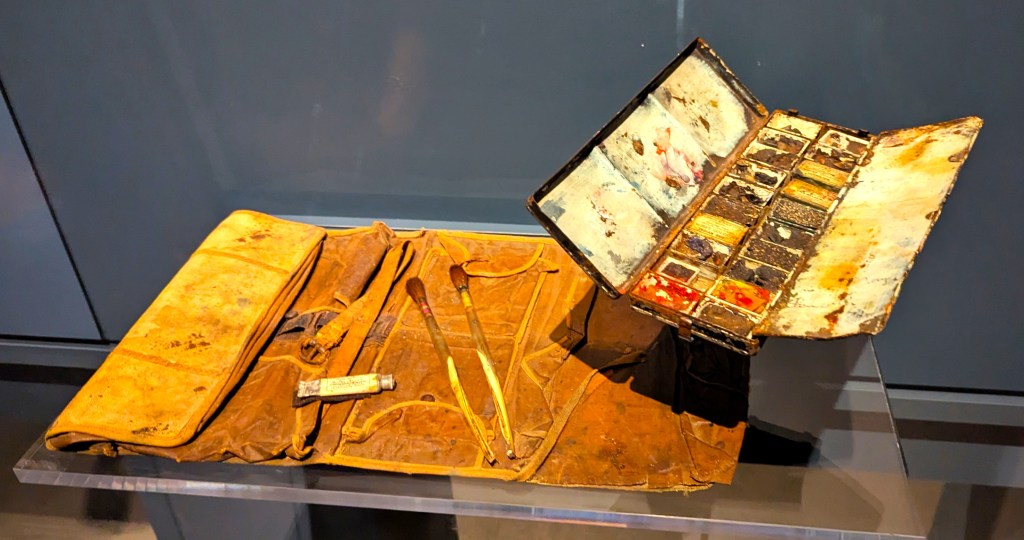
Museum tour guides may at times talk more about the artist than about the art itself, because they assume the average museum attendee doesn’t have the training to understand basic art principles. Nonsense! Try viewing a work of art using John Muir Laws’ three wonderful questions:
- “I notice…” Pick a painting in a favorite museum, and look for a tiny detail you overlooked at first
- “I wonder…” Ask yourself what the final touches may have been, ask yourself how the artist knew when to stop
- “It reminds me…” Here is where that gap between artist and observer can begin to narrow. If the painting is a landscape, does it remind you of a time last winter when the late afternoon shadows at home took your breath away? Do the masterful sky colors remind you of a day last summer that felt just as glorious?
Ponder the artwork itself, how it makes you feel, without getting up into your speculative head! Use your eyes! Use your heart! Let yourself be swept away!
I assure you that will be the best visit to a museum you have ever had. Better yet, go with a friend, stare at one painting together for at least 15 minutes, pull out your journals and do a rough sketch of it, complete with jotted notes, so you will remember what stirred your soul.
Then when the two of you end up in the museum café, comparing notes, don’t be surprised if a passerby stops, smiles, and asks, “Are you two artists?”
Feel free to smile and say, “I guess we are now. Look at that!”
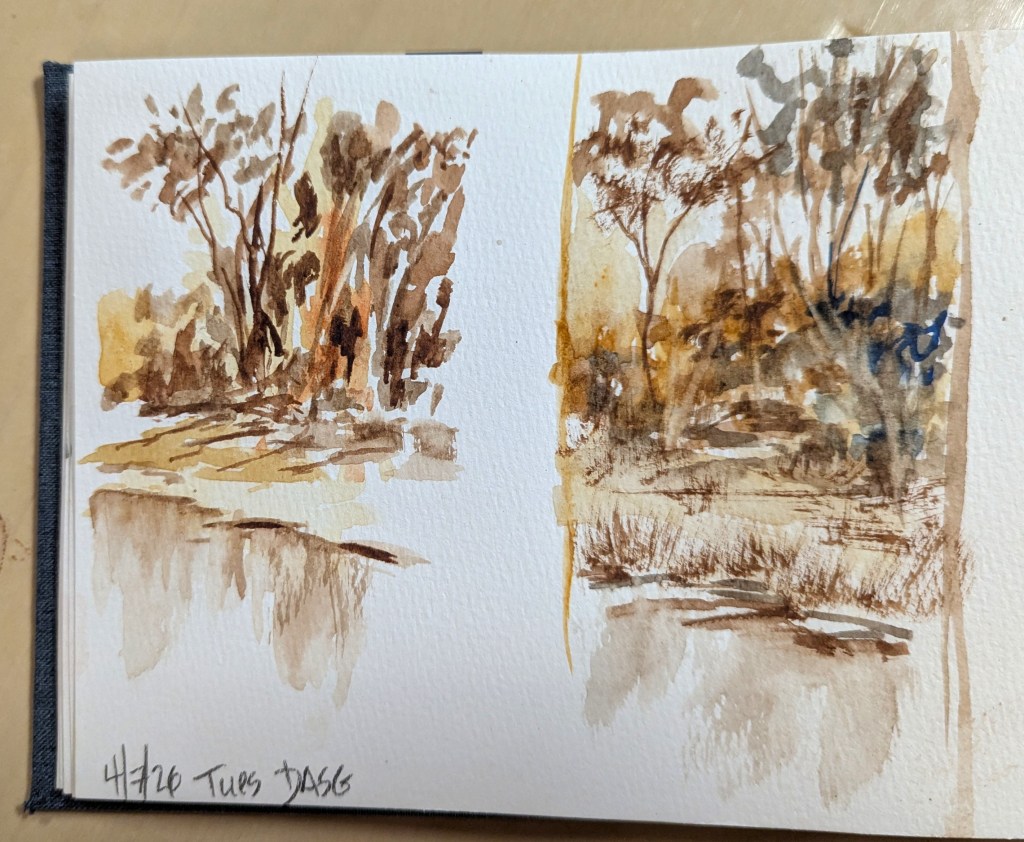
This is all imaginary, reacting to what’s on the page and adjusting as I go along.
The old standards: raw sienna, burnt sienna, raw umber, and a touch of ultramarine blue to get the dark darks.
~~~
Feel free to forward this or any post to friends and family who might enjoy them.
Click on the “Word Cloud” on the right if you’d like to read more about a specific topic.
All three of my books are available on Amazon in eBook and paperback formats. The newest book, Look at That! – Second Edition, is also available as a beautiful hardcover.
A big thank you to the recent donors to the Tip Jar. If you find these posts valuable, I hope you will contribute to The Tip Jar. It is my preferred alternative to having this be a subscription website. The Tip Jar is a secure site, and it helps keep this website solvent.
I would love to hear from you! The public “Leave a Comment” box is shown below. Private questions or comments will reach me by using the Contact link here.

 Aloft with Inspiration