1964: The summer breeze is a blend of fresh hay, saddle soap, and the sweet smell of horse sweat. At Chestnut Bay Stables, learning to be safe and responsible in the barns and on the trails long precedes any time in the show ring. Every student learns the proper way to groom a horse and care for the tack – the halters, bridles, and saddles – long before their first wobbly thrill of sitting on a horse.
Mrs. Adams, stable owner, instructor, and disciplinarian, strides into the lower barn, hat pulled low over her ever-present scowl. She is stern with her riding students, monosyllabic with their parents, and effusive with her eighteen horses. During lessons, if you didn’t learn instantly, you got The Frown. If you didn’t listen, you heard the crop whistle through the air before hitting her gloved palm. She demonstrated horsemanship as well as tough-mindedness, and most students went from fearing her, to respecting her, and finally to admiring her.
Where did Mrs. Adams, the city woman, learn to care for horses, run a business, and teach children discipline and respect? No one knew the full story, but parts of it were whispered from one child to another as they worked together using hoof picks and mane combs.
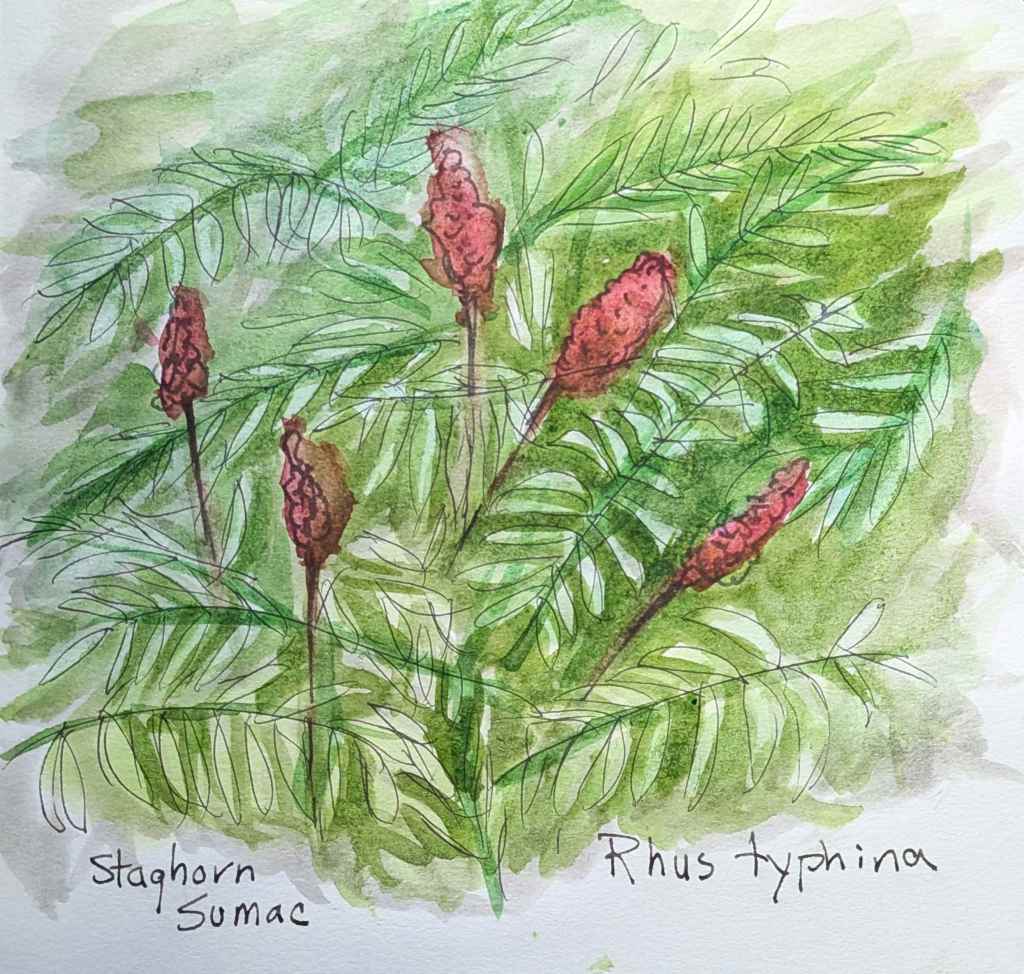
Mrs. Adams grew up in New York City and developed a severe case of arthritis in her hands at a young age. In her thirties, frustrated and needing a change of scenery, she headed north one beautiful autumn day, stopping at a farm stand near the NY/ CT border where she met Mr. Pinchbeck, a kind-hearted nurseryman who noticed Adams rubbing her swollen knuckles as they talked. Pinchbeck told her about the native staghorn sumac plant, rhus typhina, that grew wild in eastern North America. According to Native American wisdom, these sumac berries, carefully prepared, could be helpful in treating arthritis.
“I wouldn’t recommend it without trying it myself,” he smiled. “For me, it works.” He gave her the recipe and offered her a small bunch of sumac berries from his backyard. Adams thanked him and drove back to the city, eager to create her first batch of sumac tincture.
Weeks passed; she consumed daily doses of the bitter tonic, and as the pain in her hands subsided, her inspiration grew. Adams returned to the farm stand to thank Mr. Pinchbeck, and after chatting for a while, the farmer smiled. “In case you’re interested,” he said, “a farm just came up for sale about a mile from here. It’s a bit rundown, and there isn’t a lot of land, but the property includes an entire hillside covered with old sumac bushes. Just a thought…”
Adams followed his directions, drove the short distance to explore the place, and decided to become a countrywoman. She purchased the land, decrepit house, and two oversized barns surrounded by lush sumac bushes. Soon the property was a flurry of plumbers, electricians, and carpenters repairing the house enough to make it livable. Next, the workers cleared out the barns, replaced the rotting sills and floorboards, preparing for the horses that would become her genuine family.
The Lodger
After the workmen left, Adams realized she would need a full-time stable hand to create the top-notch riding academy she envisioned. Enrico knew very little English, but he spoke “horse” fluently. He was always looking down: down as he shoveled the stalls, down as he trudged up the narrow dirt path from the lower stable to the upper stable, down as he muttered his way around the property. But when Enrico walked toward a horse’s stall with wheelbarrow and shovel in hand, something magic happened. Even a wild-tempered stallion would suddenly stop and stare at him.
Robbie
Rob Roy was a great example of an ill-mannered horse who understood Enrico’s gruff, gentle ways. “Robbie,” a palomino stallion, had spent his life working (and being abused) by the owner of a traveling circus. If a riding student walked too close to his stall, Robbie would snort and lunge at them over his stall door, teeth bared, warning them to stay away.
Robbie was different with Enrico. From far away, Robbie would hear the squeaky front wheel of the manure-laden wheelbarrow, then Enrico’s trudging steps and grumbling voice as he approached Robbie’s stall in the lower stable. Robbie would nicker a low-voiced greeting as the man slowly opened the stall door and attached the chain to keep Robbie in. Enrico would then muscle the wheelbarrow, shovel, and his own wiry body under the chain and into the large box stall, muttering expletives in Italian, grumbling a heavily accented, “Back, Robbie, BACK you sumbitch…”
Enrico was the quiet boss with every horse and every person, except for Mrs. Adams, the woman who had given him a job despite his broken English and gruff manner. When she was near, he transformed into a silent devotee.
Crickets and dreams
A few years ago, after decades away, I had the chance to return to my childhood home where, as a painfully shy girl, I had been terrified of Mrs. Adams. I had even feared some of the horses. Despite all that, I stayed, tolerating the riding lessons and the demanding instruction because I loved it there, petting the gentle horses, grooming the ones that would nicker and turn their heads to lay a horse-lipped kiss on me as I curried their shiny mahogany coats.
I loved being in the stables when no one else was there. After I finished my riding lesson, rubbed down my horse, led her to her stall, cleaned the tack and put it away, I would walk up the hill, turning left at the top and across the flat area in front of the upper stable, past the towering row of sumac bushes laden with ripe staghorn berries. Stepping across the threshold of the upper stable, I would be welcomed by the nickering of six horses and the fresh scent of recently served horse feed: a pungent blend of vitamins, oats, barley, and molasses. I wonder if my current love of oatmeal raisin cookies began right there, in those stables.
On my return visit, after decades away, as my car approached the curve in the road just before the stable driveway, I could feel my heart race with anticipation.
Then, sudden disorientation.
I knew this had to be the right place, but the driveway was gone. I pulled over as best I could on the narrow road and looked up to my left. The stables, outbuildings, and main house were completely gone. The land beyond was flat; the cellar holes looked like they had been filled in long ago, leaving no discernible footprint of a place that changed my life, and the lives of so many others.
Those horses, and Enrico, and that ornery old woman had helped hundreds of girls and boys grow from giggly fillies and colts to proud, responsible women and men. Just before I drove away, I spotted a rusty horseshoe nail poking up through the sand near the old entrance. Maybe it wasn’t a dream after all.
After wiping my eyes, I drove on. Life of another sort continues there still, of course. Crickets, chipmunks, and birds finally have it all to themselves. I wonder if the trees and sumac bushes recall the sound of children’s laughter, Italian grumblings, horses whinnying, and hooves stomping. I wonder if on warm evenings, perhaps there is still the lingering scent of molasses, oats, and hay, as well as the sweet smell of horse sweat, saddle soap, and simmering sumac.
~~~~
I hope you enjoyed this essay, the first in my series called “In the Meantime,” a collection of stories about memorable odd moments in life. Feel free to forward this or any post to friends and family who might enjoy them.
Click on the “Word Cloud” at the right if you’d like to read more about a specific topic.
All three of my books are available on Amazon in eBook and paperback formats. The newest book, Look at That! – Second Edition, is also available as a beautiful hardcover.
A big thank you to the recent donors to the Tip Jar. If you find these posts valuable, I hope you will contribute to The Tip Jar. It is my preferred alternative to having this be a subscription website. The Tip Jar is a secure site, and it helps keep this website solvent.
I would love to hear from you! If the public “Leave a Comment” box does not show below, just click on the title bar of this (or any) post and it will magically appear.
Private questions or comments will reach me by using the Contact link here.
Thanks for spending some time with me aloft!

 Aloft with Inspiration