Our ability to hear and our ability to listen are very different skills. They are as complex as the abilities to look and to see.
Oxford language definitions:
Hear – Verb: perceive with the ear the sound made by (someone or something)
“behind her she could hear men’s voices”
Similar: perceive, catch, apprehend, discern
Listen – Verb: give one’s attention to a sound
“evidently he was not listening”
Similar: pay attention, attend, concentrate on
We all know the difference, of course. Here are a few questions to ponder:
Listening to humans
How many minutes a week do you think you spend talking?
How many minutes do you spend listening to people you are with?
How many minutes a week do you spend listening to human voices in all forms: in person, on the phone, and on TV programs, films, social media voices, radio interviews? That probably adds up to a lot of minutes. Because of that, do you notice you sometimes stop listening to human voices, even though you can still hear them? Interesting.
Listening to Other Sounds
How much time in a week do you spend listening to instrumental music?
What about listening to just the sounds outdoors, like birds and traffic and doors slamming and dogs barking and the wind in the trees? How often do you “hear” any of those sounds without really hearing them, simply because your mind is elsewhere?
Listening with Just Our Ears
Perhaps you think you already listen with just your ears, but I bet you don’t. More than likely, you also listen to your internal dialog, when you are alone as well as when you are with others. At times, that internal dialog sounds like listening to an overly enthusiastic drunken sportscaster making pithy comments about everything you just heard, or every little thought you had. No wonder we get distracted when trying to listen! Serious mental cacophony!
I Invite You to Begin Building an Internal Mute Button
Here is the challenge. The next time you’re with a group of people in person, try to listen the way you would if you didn’t speak their language. Listen to the resonance, the tempo, the rhythm of their words. Listen for hesitancies: are they deciding what to say, or how to say it?
Then switch to listening with such focus that you do hear what they said, and how they said it, while being oblivious to any of your own internal dialogue. It’s not easy.
Years ago, I had a coworker who was from another country. In his culture, people never interrupted. Not only did no one ever interrupt anyone, for added insurance an extended silent pause occurred whenever a person finished talking. Always. One day I was having a conversation with him, and he was saying something I agreed with. While he was still talking, I smiled, nodded, and whispered, “yeah,” just to signify agreement. He stopped speaking immediately, a bit stunned I had interrupted him, and politely said, “Go ahead.” I was mortified. I know now that there’s listening, and there’s listening.
The Ultimate Listening Challenge
OK, it’s confession time. Listening is not one of my strongest skills, not by a long shot. I’m embarrassed to say that, but it’s true. I spend a great deal of time alone, so when I’m with friends I find myself brimming with enthusiasm about my latest project / ideas / revelations, so I rarely lead with listening instead of talking. It’s a serious weakness. That is why I’m thrilled to tell you about a book that is changing my life.
The book is called, “The Next Conversation: Argue Less, Talk More” by the now-famous, delightful lawyer / author Jefferson Fisher.
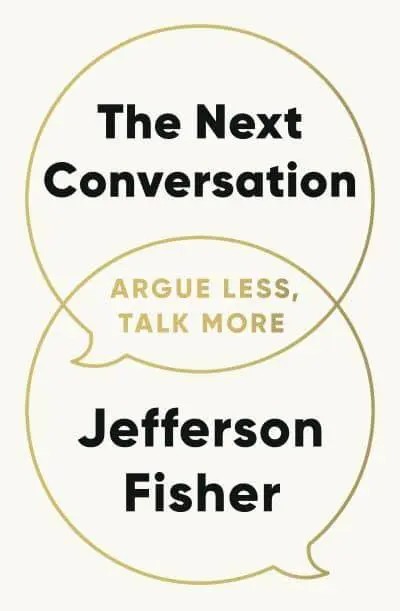
Many of us discovered him on Facebook or Instagram and immediately hit the “follow” button because his wisdom, humor, and advice are so down to earth, readily applicable, and much needed in current times.
Here’s my other recommendation: I encourage you to buy the Audio Book, even if you want the paperback too. Fisher narrates the book himself, and as he reads along, you can hear his smile, you hear the pacing of his words, when he hesitates for emphasis, his nuanced inflections, how he stresses key phrases. The book is dripping with wisdom and grace. I may end up getting a hard copy too, just so I can highlight words and phrases that I want to remember and practice. Here’s the link to the book on Amazon – just listen to the free 5-minute audio sample and hopefully you’ll be hooked too.
What do you think is the power and purpose of deep listening?
Here are some of my ideas:
If you are a wonderful listener, you will effortlessly learn things that you never even thought to ask about.
As you become a better listener, that chatter in your head will quiet down a bit, little by little, because you’ll be flooded with curiosity instead.
When I build my listening skills by paying attention to sounds that don’t include language, a whole new world opens up.
So what are some of your favorite sounds?
Not music, because we already talked about that a few weeks ago. How about other kinds of sounds? Here are some of mine:
I love the whistle that comes from the wind blowing through evergreen woods, and how fir trees sound different from pine trees.
My favorite bird call is the wood thrush, it’s so haunting. (Side note: there aren’t many wild bird sounds I don’t like, proven because even blue jays sound fine to me.)
I live in a city, and I’ve discovered that cars driving over very wet pavement can sound like the ocean from a distance. Also, my ancient cast iron radiator gently gurgling on a chilly day like today is a very welcome sound indeed!
I live across the street from a church that has lovely carillon bell rehearsals at 4pm most days, and it is a joy to hear it, especially that one bell that is slightly out of tune. It makes me smile every time – no perfectionism allowed, not even in church!
There is a website called “tree.fm” (what more could you want?) where you can listen to samples of forest sounds from around the world. Here is the link. https://www.tree.fm/
Desert-Island You is Almost Ready to Soar
Earlier this month we identified our favorite piece of art, our favorite music, our favorite childhood fairy tale, our favorite subject to be curious about. This is all time well spent, but why? Because this month we are building a tiny carry-on triage suitcase for “Desert-Island You” to have packed and ready for when, because of unexpected circumstances, you may feel you’ve lost track of who you really are. It’s a bit like a magic mirror, but oh so much richer.
Enjoy rediscovering your favorite sounds to add to your adventure kit packing list. Feel free to share them below in the comment section! (Click on the title of this essay if you don’t see the comment section immediately.)
~~~~~~~~~~
I hope you enjoyed this essay. Click on the “Word Cloud” at the right if you’d like to read more about a specific topic. Feel free to forward any of them to friends and family members who might enjoy them.
Public comments can be posted below. (You may need to click on the title of this essay to access the “Like” and “Comment” areas.)
Private questions or comments will reach me by using the Contact link here.
All three of my books are available on Amazon in eBook and paperback formats.
The newest book, Look at That! – Second Edition, is also available as a beautiful hardcover.
A big thank you to the recent donors to the Tip Jar on this blog. If you find these posts valuable, I hope you will contribute to The Tip Jar. It is my preferred alternative to having this be a subscription website. The Tip Jar is a secure site, and it helps keep this website solvent.
As always, thanks for spending some time with me “aloft.” Happy gazing and sketching!

 Aloft with Inspiration