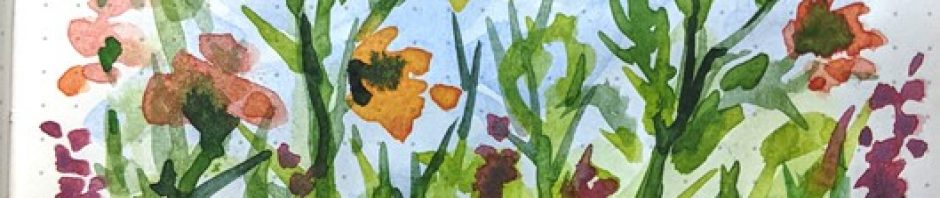
As I mentioned last week, I am navigating a couple of medical challenges that leave me with very little energy to do extra things, even those things that normally rejuvenate me. Then I glimpse my sketchbook on the table…. next to my favorite watercolor palette…
Let me be clear, though. I don’t love painting.
I love “watercoloring.”
I know it’s not a proper word, but it is for me.
I have no interest in exploring painting using oils or acrylics or ink or using any media for printmaking or collage or many other stunning art creations.
But I do swoon for watercolor.
When visiting a museum, I appreciate all the works of art, but on the rare occasion that a watercolor is on display, my heart suddenly races. I head straight for the docent/guard to tell them that because of my poor eyesight, I plan to get very close to the artwork, but that I understand the required distance the museum dictates to viewers, and I promise to respect the rules. The docent usually thanks me, relieved that the crazed museum guest is fully aware of the rules. They still keep an eye on me though, because I suddenly look like I’m on a mission.
Many of the best museums have priceless watercolors in their collections, but they are rarely on display because any light at all will eventually degrade both the paper and the watercolor paint, even if both are of the highest quality.
That explains why in 2023 I made two trips to Harvard’s Fogg Museum, to attend the exhibit entitled “American Watercolors: 1880-1990 Into the Light.”
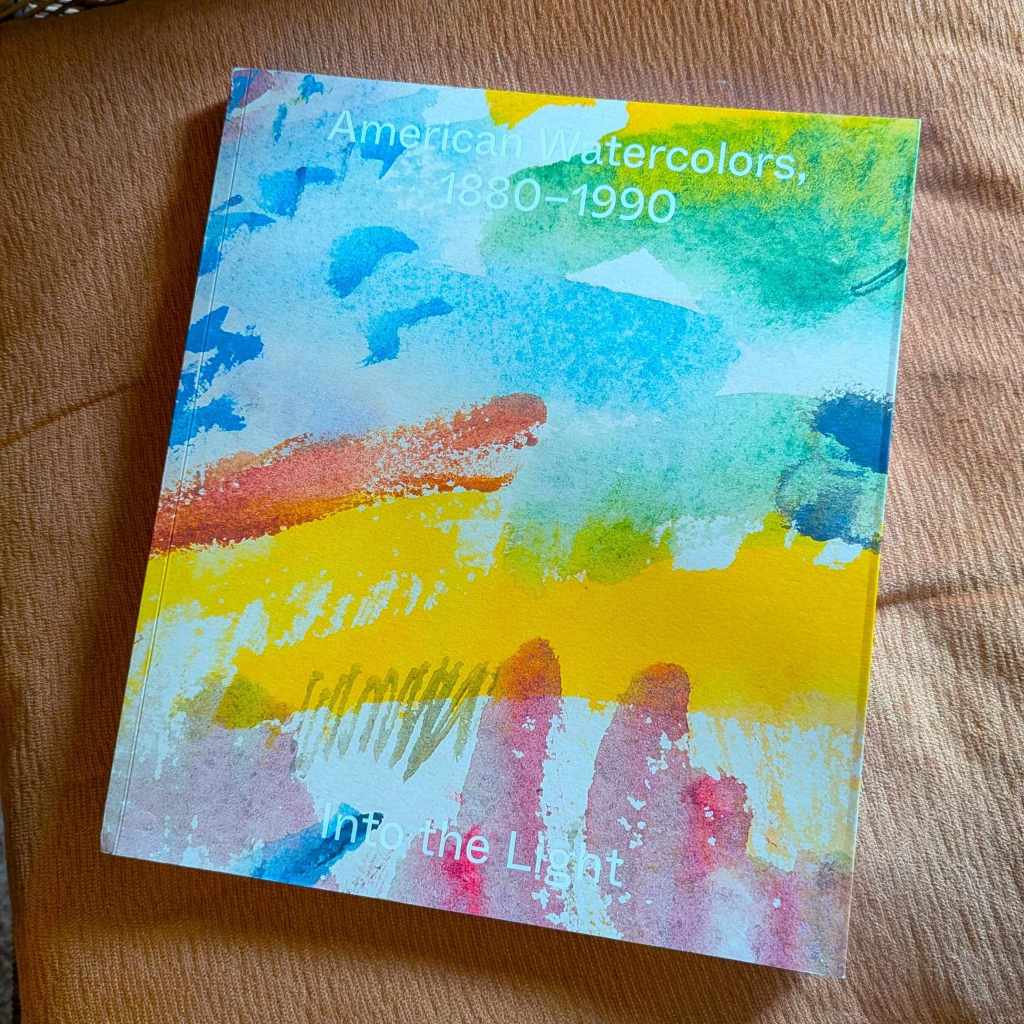
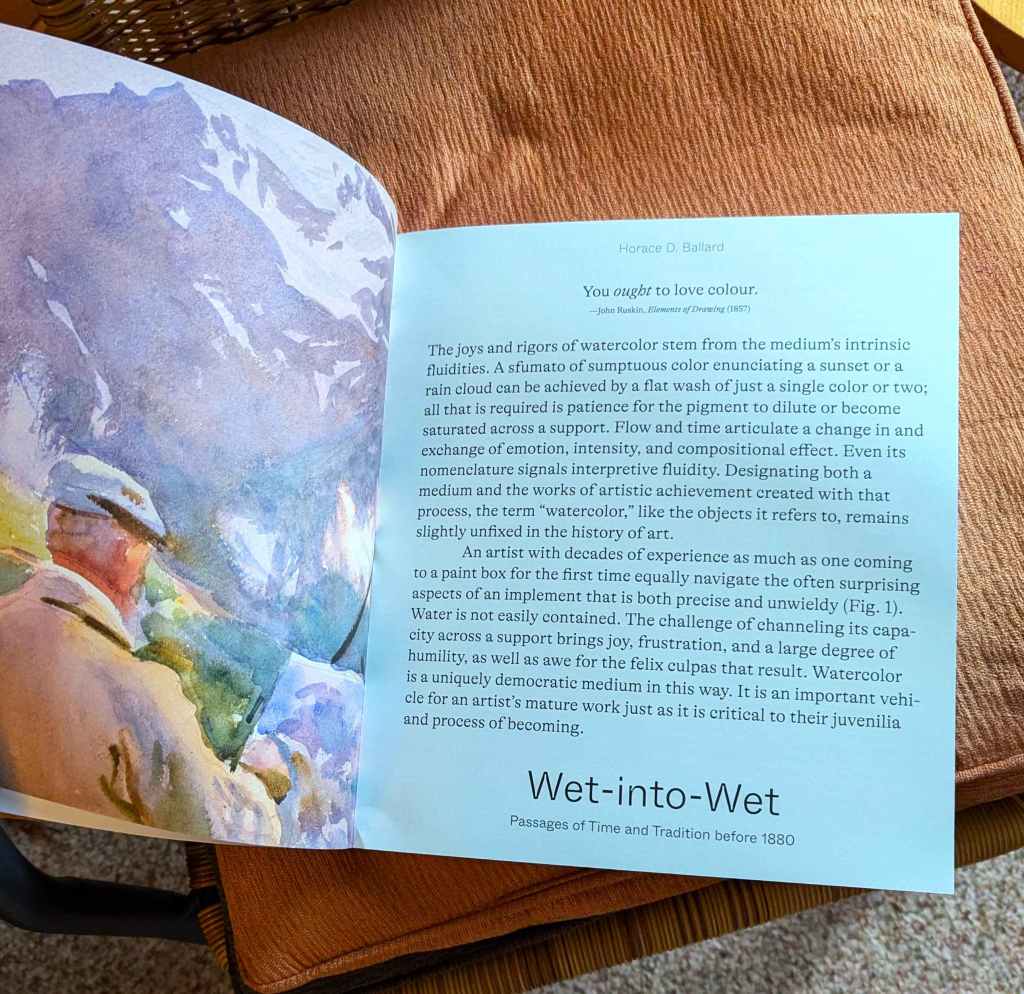
A friend gave me a copy of the exhibit book, a stunning 184-page beauty. I highly recommend it.
So, as I explained last week, the best cure for being uninspired is to find something wonderful to emulate. (That’s life instruction as well as art instruction.) This week I chose another work of art from the Currier Museum collection, an oil painting by Willard Metcalf entitled “The Trout Brook.” My watercolor sketchbook is small, so I knew my sketch area would be only about 5” x 7.” An inspiration came to me out of nowhere: Despite the small image area, why not use my powerful Ron Ranson hake brush for the whole thing?”
If you’ve never used a hake brush, I highly recommend it, but get ready for a wild ride. If your work is often too fussy, get a hake. If you tend to be timid, get a hake. If you want to learn to feel like a magician, get a hake.
Warning: there are many cheap knockoffs out there that will never work well for you, so I recommend the Ron Ranson brand of hake produced by ProArte (surprisingly inexpensive.) They are available through Cheap Joes, Pro Arte, and Jackson’s Art Supply. They are made with goat hair (the proof is in the close-up smell when it’s wet!), and they take some breaking in. Don’t get discouraged during the “getting-to-know-you” phase, though; it is well worth it. Here’s a link to a brief demo by the master himself, Ron Ranson.
You may notice that my lovely small Ranson hake shown in this picture looks a bit butchered.
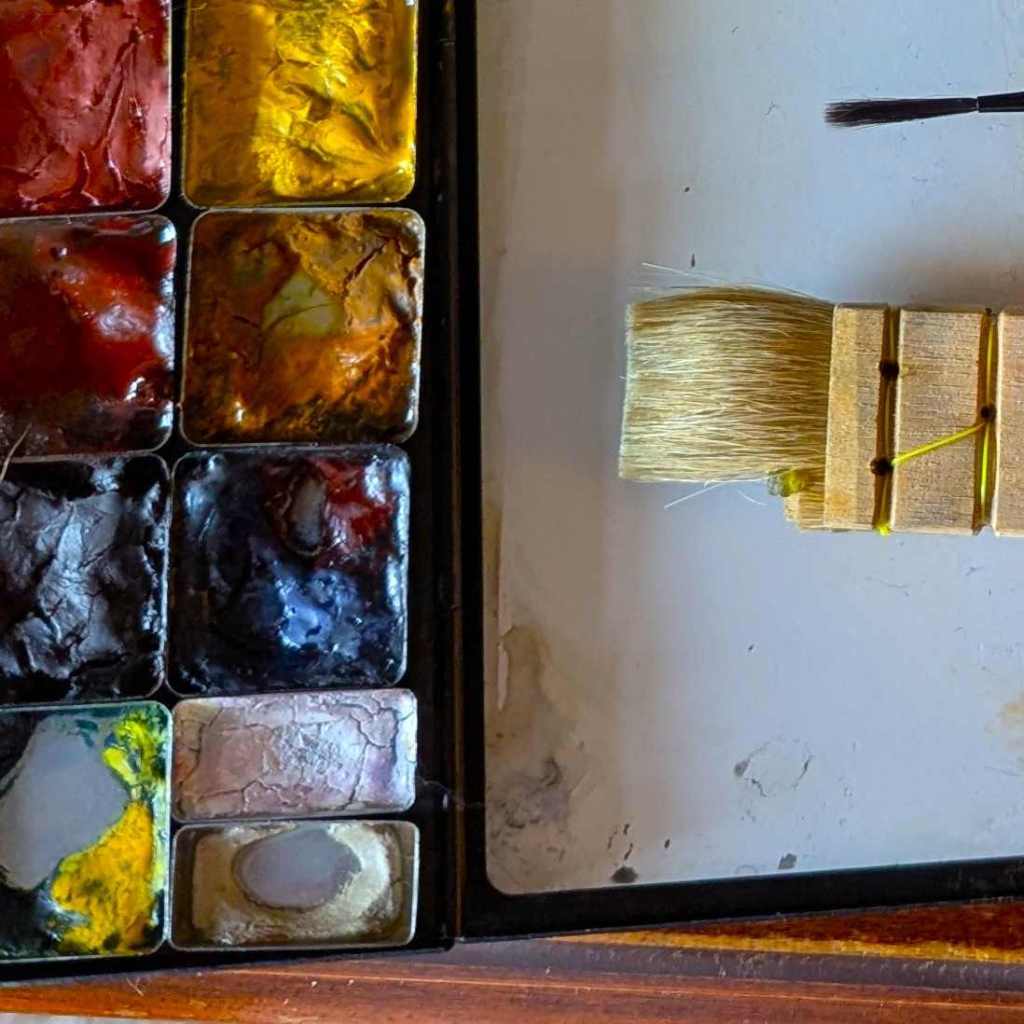
I have three other well-loved hakes that I still use often, that had no need of haircuts, but this time I wanted to customize one to fit comfortably within the square pans of my Expeditionary Art Folio palette. The small hake was just a bit too wide to fit within the pan, so I pushed a toothpick through at the width that I needed, took a deep breath, and gave it a haircut, right to the ferrule. Cringe-worthy brush abuse! It looks awkwardly splayed out when it is dry, but when wet, it works like a charm. This brush (and the years I have spent befriending it), is responsible for the sparkle on the water, the textures in the field and trees, and the general freshness overall.
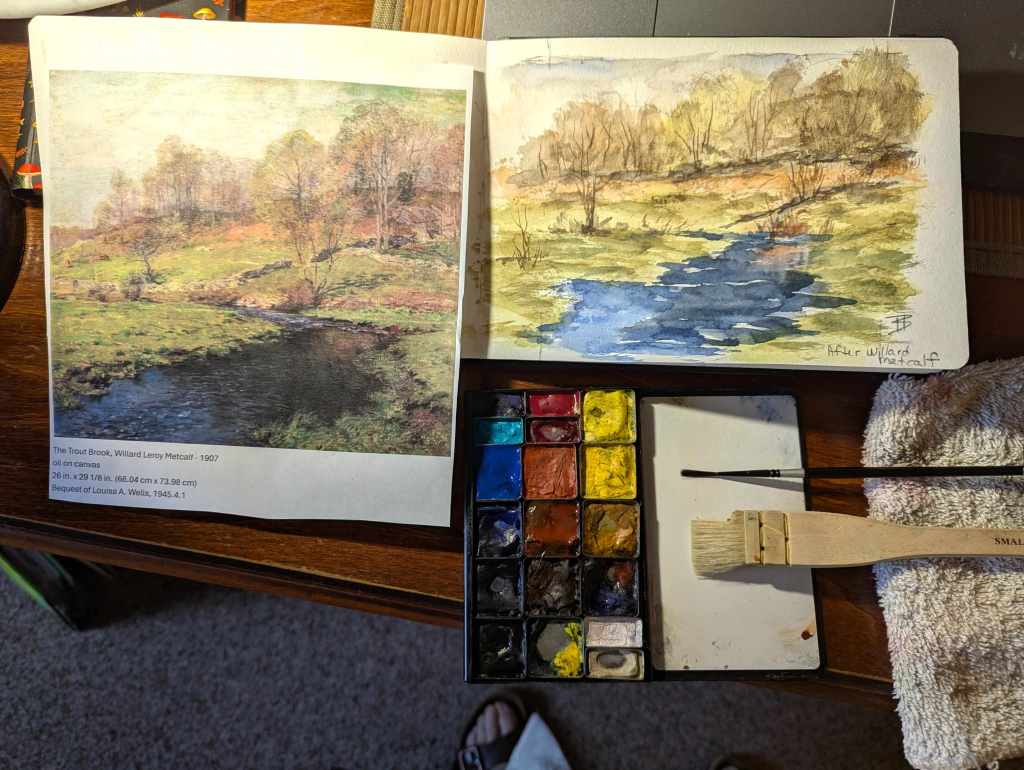
Because hake brushes are so thirsty, you will frequently want to use a thick washcloth or towel to squeeze it out or dab off the extra wetness and paint. That way you will be able to use one brush from start to finish to create juicy skies, distant hills, a cluster of trees, as well as water-sparkle and crunchy foreground grasses. Yes, all with one brush.
When I was satisfied with the final painting, I added a few minor touches with a rigger, not much though. It’s a bit like putting on one’s pearl earrings when finally fully dressed. The outfit is the point, not the accessories.
- Here’s what you need to enjoy painting as much as I just did:
- Watercolor palette set up with full pans, not half-pans (not too many either, 12 is plenty)
- Decent watercolor paper
- A small or medium hake brush
- A dedicated fat washcloth that will become beautifully stained forever
- An assistant to pull your brush out of your hand before you overwork it!
- A dedicated fat washcloth that will become beautifully stained forever
- A small or medium hake brush
- Decent watercolor paper
- Watercolor palette set up with full pans, not half-pans (not too many either, 12 is plenty)
(P.S.- After lots and lots of practice, you will be able to forego the assistant…)
Enjoy, and comment below to let us all know if you love a good hake brush too!
~~~~~
I hope you enjoyed this essay. Click on the “Word Cloud” at the right if you’d like to read more about a specific topic. Feel free to forward any of them to friends and family members who might enjoy them.
Public comments can be posted below.
Private questions or comments will reach me by using the Contact link here.
All three of my books are available on Amazon in eBook and paperback formats.
The newest book, Look at That! – Second Edition, is also available as a beautiful hardcover.
A big thank you to the recent donors to the Tip Jar on this blog. If you find these posts valuable, I hope you will contribute to The Tip Jar. It is my preferred alternative to having this be a subscription website. The Tip Jar is a secure site, and it helps keep this website solvent.
As always, thanks for spending some time with me “aloft.” Happy sketching!

 Aloft with Inspiration